Ohio Ag Net | Ohio's Country Journal Ohio Ag Net | Ohio's Country Journal

One year after researchers at The Ohio State University College of Food, Agricultural, and Environmental Sciences (CFAES) first confirmed red crown rot in Ohio, they are asking growers to help answer a critical question: How widely has this potentially damaging disease spread?
The answer could have significant implications for Ohio soybean production. Red crown rot, caused by the soilborne fungus Calonectria ilicicola, can persist in fields for years, making early detection and accurate diagnosis especially important.
“This is an important time to scout because red crown rot symptoms become most visible during the reproductive stages of soybean, particularly during pod fill,” said Horacio Lopez-Nicora, associate professor of soybean pathology and nematology and a Provost’s Early Career Scholar at CFAES. “August and September are an excellent window for growers to walk fields and look for patches of plants showing premature yellowing, interveinal chlorosis and necrosis, wilting, or plant death.”
Recent record rainfall and resulting wet conditions make scouting especially timely because red crown rot is favored by warm, wet soils.
CFAES researchers confirmed Ohio’s first case in a Delaware County soybean field in 2025. A year later, they still don’t know how widely the pathogen may be distributed across the state.
“That is one of the major questions we are trying to answer,” Lopez-Nicora said. “Growers, crop consultants, and Ohio State University Extension educators can play an important role by scouting fields and submitting suspicious plants for diagnosis.
“The more samples we receive from across Ohio, the better we can begin to understand where this disease is occurring.”
Question: What should I do if I suspect red crown rot in my soybeans?
Answer: Growers who suspect red crown rot or SDS can mail or deliver whole soybean plants, including roots, to Soybean Pathology and Nematology, 110 Kottman Hall, 2021 Coffey Road, Columbus, Ohio 43210, for diagnostic testing at no charge.
The stakes are significant.
In states where red crown rot is established, yield losses in severely affected fields can reach 80%, while moderate disease pressure can reduce yields by 15% to 70%, Lopez-Nicora said.
“For Ohio, if the disease spreads unchecked, growers could face persistent yield reduction and higher production costs year after year, threatening the profitability of the state’s most widely planted crop,” he said.
Detection is complicated by red crown rot’s resemblance to sudden death syndrome (SDS). Both can cause yellowing and browning between leaf veins that remain green.
“That is why growers should not diagnose red crown rot or sudden death syndrome based on foliar symptoms alone,” Lopez-Nicora said.
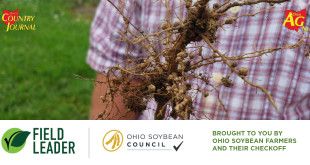
Growers should dig up suspicious plants and examine the lower stem, crown and roots. Red crown rot can produce reddish discoloration near the soil line and small red fungal structures on crown and root tissues.
With support from the Ohio Soybean Council and United Soybean Board, Ohio State’s Soybean Pathology and Nematology program is offering diagnostic testing at no charge for soybean samples suspected of red crown rot or SDS. Each sample also helps CFAES researchers better understand where the diseases are occurring.
For growers, Lopez-Nicora’s message is simple: “If you see suspicious symptoms, scout, dig and submit,” he said. “Do not rely on the leaf symptoms alone. Dig up the entire plant, including the roots, and send it to us for diagnosis.”