 Ohio Ag Net | Ohio's Country Journal Ohio Ag Net | Ohio's Country Journal

By Vinayak Shedekar, The Ohio State University
Many Ohio farmers are familiar with the pattern in subsurface-drained fields: corn growing directly above tile lines often appears taller and healthier than corn growing between laterals. As spring rainfall events intensify and suitable fieldwork windows shorten, some producers are responding by installing tile systems with spacings as narrow as 15 to 20 feet. But is narrower always better?
Drainage spacing recommendations have traditionally been based on crop susceptibility, soil texture, and soil permeability. Yet interest in narrower spacings is growing across northwest Ohio, even in fields originally tiled to recommended designs. Although research on very narrow spacing systems remains limited, several important considerations can help producers evaluate whether narrow spacing is likely to provide a return on investment.
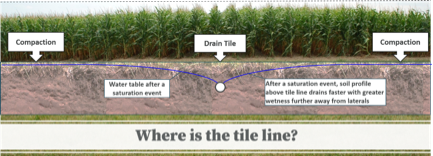
Because installation costs increase substantially as drain spacing narrows, expected yield benefits should be weighed against the added investment.
Why are narrower spacings becoming more common?
One reason is changing weather patterns. Many farmers have experienced wetter springs, larger rainfall events, and fewer opportunities to get into fields in a timely manner. Narrower drain spacings generally allow excess water to move more quickly toward tile lines, resulting in faster water table drawdown after rainfall events. This can improve trafficability and may help create more favorable conditions for planting and crop establishment. However, improved drainage performance is only part of the story.
Is drainage really the problem, or is it compaction?
In some cases, poor crop growth between tile lines may not be caused by inadequate drainage design. As shown in the the figure, soil farther from the drainage laterals tends to remain wetter longer than the soil directly above the drains. Repeated traffic on wet soils can create compaction layers that restrict water movement and root growth. It may take only one or two wet springs for field traffic in these wetter areas to create severe soil compaction. Thus, in some situations, narrowing tile spacing may be addressing a compaction problem rather than a drainage problem. Before investing in additional tile, it may be worth evaluating whether compaction is contributing to the problem and considering less expensive remediation options.
What about water and nutrient losses?
If a narrower drainage system is installed at the same depth as a wider-spaced system, it can result in more rapid water table drawdown and potentially greater nutrient losses through drainage water. For that reason, conventional drainage design principles often suggest using shallower drain depths when moving to narrower spacing. A shallower installation can frequently provide the desired drainage intensity while reducing unnecessary water removal and nutrient export from the field.
New opportunities for water management

Narrower drain spacing may also create opportunities for practices like controlled drainage and sub-irrigation. In relatively flat fields, these practices tend to operate more efficiently and uniformly when drain laterals are installed closer together. By managing water levels throughout the year, producers may improve water conservation, enhance crop performance, and reduce nutrient losses from the field.
If you would like to learn more about drainage design, controlled drainage, or sub-irrigation, the 2027 Overholt Drainage School may be a valuable training opportunity. Additional information is available at go.osu.edu/agwater and transformingdrainage.org.
This column is provided by the OSU Department of Food, Agricultural and Biological Engineering, OSU Extension, International Program for Water Management in Agriculture, Ohio Agricultural Research and Development Center, and the College of Food, Agricultural, and Environmental Sciences.
Dr. Vinayak Shedekar is the Assistant Professor of Agricultural Water Management and director of the Overholt Drainage Research and Education Program in the OSU Department of Food, Agricultural and Biological Engineering and can be reached at shedekar.1@osu.edu


