 Ohio Ag Net | Ohio's Country Journal Ohio Ag Net | Ohio's Country Journal

By Luke Schulte, Field Agronomist, Beck’s Hybrids
This year has brought many weather extremes, including record rainfall in August. As the saying goes, “rain makes grain.” However, days on end of rain, cloudy conditions, and humidity in mid-August have also raised another concern: vomitoxin (VOM) potential.
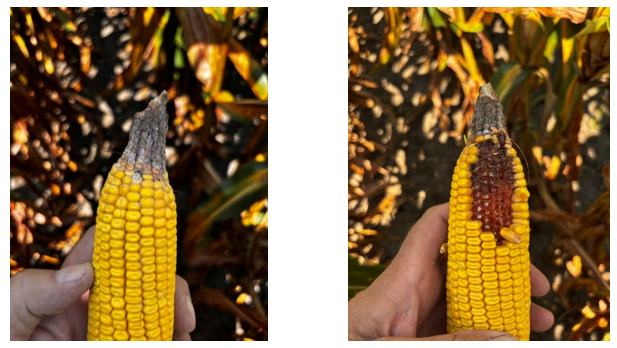
For many, July remained fairly hot and dry, and by Aug. 1 the risk of vomitoxin appeared low. However, the persistent high-moisture conditions from Aug. 10-21 have led to the development of gibberella ear mold, which often manifests as vomitoxin-infested grain.
The good news is I anticipate many will also see very good yields, particularly on the well-drained acres planted early. These acres have had the opportunity to alter their DNA (stress memory) based on a multitude of stresses: dry early, cool and wet May, dry again, and wet late. When plants experience a specific stress a second time (e.g., wet), after enduring it earlier, they can alter genes to handle the repeated stress better.
August rainfall for Ohio and Indiana was record-setting in many counties. However, the never-ending rain led to unprecedented humidity levels, which are a primary factor in gibberella ear mold infection.

Ohio State University- Western Branch Research Station
(South Charleston, Ohio)
According to The Ohio State University, relative humidity > 80% after silking has demonstrated some of the strongest positive correlations to VOM contamination. While humidity is a significant factor, higher plant populations also intensify gibberella ear mold and, in turn, VOM.
Management moving forward
As irritating as VOM-infested corn is at harvest, proactive management can minimize the detrimental impact of grain dockages and recurring problems in storage all winter long.
The majority of the mycotoxins, or VOM, are within the fines and bees’ wings. According to a grad student at The Ohio State University whose research project focused solely on understanding and managing VOM, “I’ve never seen gib in the grain without being in the cob as well.” Bees’ wings are a component of the cob, so their removal is essential.
Harvest: Removal of fines/bees’ wings
- Combine settings and modifications
- Utilize fan speed to “blow” out shriveled/damaged kernels
- Perforated screen under clean grain elevator
- Perforated screen under return elevator; if VOM levels are very high, remove door
- Watch THIS beneficial video explaining the above modifications
- Harvest infected corn when fodder is dry
- Utilize grain cleaner before/after dryer
Drying and storage
- Core bins immediately
- Utilize grain cart upon loadout, as handling may allow for wind to remove additional fines/bees’ wings
- Store grain at ≤ 15% moisture to prevent further fungal growth
- Dry immediately (within 48 hours of harvest)
- Store grain at 36-44°F and maintain aeration
Prioritize and designate
- Harvest infected fields as early as possible to limit fungal growth on the ear
- Segregate infected grain if possible
Hauling stored grain
- Deliver grain harvested at higher moisture first. Additional fines were likely created.
- Haul early, as warm, moist pockets within storage will grow
- End-users will vary on VOM allowance
- Feed mills and ethanol production will likely be more restrictive
While not ideal, taking these measures above will likely help to minimize the headaches of dealing with VOM-infested grain at the elevator and throughout storage.


