For this 2026 harvest Cab Cam, brought to you by Precision Agri Services, Ty hops in the combine with Brad Williams in Highland County. Despite the challenging growing conditions throughout the summer, beans in that part of the state are turning out alright, but the corn may be really good.… Continue reading
Agricultural spray drones continue to gain momentum across Ohio, and a newly formed statewide association aims to unite operators through advocacy, education, and the sharing of best management practices. Dr. John Fulton of The Ohio State University discusses the group’s goals, including representing the industry on policy issues and helping operators navigate this rapidly evolving technology. He also shares how spray drones are creating new opportunities for farmers and custom applicators by improving the ability to make timely applications when field conditions, weather, or labor challenges arise.
For the first Cab Cam of the 2026 harvest, brought to you by Precision Agri Services, Ty heads to Warren County to visit with Mike Lutmer. Find out how his soybeans are turning out and why he is using a row crop header in this particular field. They also talk about the prospects for Ohio’s hay crop, which may be concerning for those looking for higher quality hay.… Continue reading
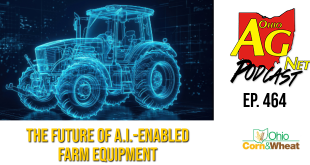
Artificial intelligence is quickly becoming more than a buzzword in agriculture. As farmers manage tighter operating windows, labor challenges, rising input costs and increasingly complex field conditions, Artificial intelligence-enabled equipment is helping turn machine data into decisions and action directly in the field. On this Ohio Ag Net Podcast, powered by Ohio Corn and Wheat, AGCO’s Andrew Sunderman shares what farmers need to understand about where AI is headed in agriculture.
Plus, the late-season rains are beneficial to the later planted corn and soybeans, but they could be a detriment as far as mold, disease, sprouting, stalk quality and vomitoxin. James Jacobs with Seed Genetics Direct has some insights on how mud may not be the biggest challenge for farmers this fall.
It was a wet week for the 2026 Farm Science Review, but that didn’t stop farmers and agriculture enthusiasts to make their way to the Molly Caren Ag Center to check out all of the new technologies and ideas that lie ahead for agriculture. We visited with several of the exhibitors throughout the week. Here are some highlights from those conversations.
National Farm Safety and Health Week is Sept. 21-25, 2026. This annual event reminds us that the choices we make today shape the success of tomorrow. The theme “Safety Today, Success Tomorrow” highlights the critical connection between safe work practices and the productivity and sustainability of our farms, ranches, and agricultural communities.
Agriculture remains one of the nation’s most demanding occupations, making safety awareness and injury prevention essential for everyone involved, from farmers and farm families to agricultural workers and youth. Taking time to identify hazards, maintain equipment, use proper personal protective equipment, and prioritize physical and mental well-being can prevent injuries and save lives. The Fatal Five for Ohio farmers are highlighted here.
1. Tractor and machinery incidents
Tractor rollovers, runovers, PTO entanglements, and injuries involving moving machinery remain the leading causes of severe injuries and fatalities. These injuries rise during harvest season, when there is increased exposure to hazards.… Continue reading
Artificial intelligence is moving from the realm of emerging technology into the cab, field and farm shop, with agricultural equipment manufacturers increasingly integrating AI into machines and systems designed to help farmers improve productivity, efficiency and decision-making.
The Association of Equipment Manufacturers recently released a new whitepaper examining the growing role of artificial intelligence in agricultural equipment. “AI in Agriculture Equipment: Supporting Productivity, Efficiency, and Decision-Making Through Technology” outlines how the technology is being incorporated into equipment and evolving into a tool for addressing increasingly complex challenges facing farmers.
“AI technology is proving to help farmers in their efforts to be productive and competitive, especially as operational challenges continue to intensify for the ag industry,” said Austin Gellings, AEM senior director of agricultural services, who oversees the AEM Ag Technology Leadership Group that developed the whitepaper.
The report breaks AI integration in agricultural equipment into three primary levels, ranging from technologies that assist farmers to systems capable of operating with greater autonomy.… Continue reading
As farmers begin making plans and negotiating arrangements for the 2027 growing season, current custom farming rates can provide a useful benchmark when evaluating farm leases, custom work agreements, and other production costs. Ohio State University Extension’s 2026 Ohio Farm Custom Rates survey provides data from 343 farmers, custom operators, farm managers and landowners across the state. While actual rates will vary based on equipment, location, field conditions, and other factors, the survey offers valuable information to consider when negotiating rates and making 2027 farm business decisions.
By Barry Ward, Assistant Professor & Leader, Production Business Management; Eric Richer, Associate Professor & Field Specialist, Farm Management; John Barker, Assistant Professor, Agriculture/Amos Program, Knox County Ohio State
Custom rates increased for the majority of field operations in 2026 compared to surveyed rates in 2024, but the increases varied by operation. Examples include an increase of 4% for planting corn (30 inch rows with fertilizer application), 11% for harvesting corn (Combine, grain cart, haul local to farm), 12% for variable rate fertilizer application, 7% for spraying (Self-propelled sprayer), 9% for disk chisel, and 16% for tractor rental (Tractor/Horsepower/Hour).… Continue reading
Walk the grounds of Farm Science Review (FSR) this September, and you can move through generations of agriculture in a matter of minutes.
Combines work the fields, researchers turn plots into living laboratories, and farmers gather around new equipment to see what might make a difference back home. Questions about crops, weather, markets and technology move out of the office and into conversations, demonstrations and hands-on learning.
That combination of past, present, and future takes on added meaning in 2026.
As the nation marks its 250th anniversary, Farm Science Review will help launch America 250-Ohio’s October theme, “Ohio Grows: Food & Farms.” America 250-Ohio will spend October connecting agriculture’s history with the people, research and innovation shaping its future.… Continue reading
For many farmers, the grain yield monitor is one of the most important precision agriculture tools on the farm. Yield maps help identify high- and low-performing areas, evaluate hybrid and variety performance, assess management practices, and guide future decisions related to fertility, drainage, seeding rates, and other inputs. In short, yield data often becomes the foundation for many precision agriculture decisions. However, the old saying still applies: “garbage in, garbage out.” If a yield monitor is not properly calibrated, the resulting maps and analyses can be misleading and may lead to costly management decisions.
Modern yield monitors estimate yield using several sensors, in particular grain flow (lb./sec), grain moisture, travel speed, and header position (turns data logging on and off). The mass-flow sensor, located near the top of the clean grain elevator, is particularly critical because it converts grain impact into an estimate of grain flow.… Continue reading
Don’t miss the Paul Bunyan Show — happening Oct. 2-4, celebrating 20 years at The Guernsey County Fairgrounds. Get ready for an unforgettable weekend of machines, sawdust, and lumberjacks, plus some special surprises to celebrate! Visit thepaulbunyanshow.com to grab your tickets now. Advance sales end before the show—save money, time, and skip the line!
“It’s not simply the Association’s trade show,” said Jenna Reese, Executive Director of the Ohio Forestry Association, “The Paul Bunyan Show is a three-day exposition of Ohio’s forest products industry.” The Paul Bunyan Show was started in 1957 and has maintained it’s dedication to showing the heart and breadth of the industry since its inception.
Roughly 170 exhibitors will showcase their newest products at the Guernsey County Fairgrounds in Old Washington (Cambridge). Many will include live equipment demonstrations.
Husqvarna (Booth #503-506) and Tigercat (Booth #486, 487, 491, 492) are the Paul Bunyan Show’s title sponsors. This is Husqvarna’s 20th consecutive year as a title sponsor.… Continue reading
Carbon sequestration means capturing carbon dioxide (CO₂) from the air and storing it safely (particularly in plants, soils, oceans, or underground). This helps reduce greenhouse gases such as CO₂, methane, and nitrous oxide that contribute to climate change.
There are both nature-based and technology-based approaches to achieving carbon sequestration.
Soil Carbon Sequestration: Agricultural practices such as no-till, cover crops, and manure help retain and protect soil carbon. These practices also help improve soil health and crop production.
Biological Carbon Sequestration: Refers to storing carbon in plant matterby leveraging natural ecosystems such as forests, peatlands, and coastal wetlands. Carbon sequestration occurs when plants use atmospheric CO2 during photosynthesis and store carbon in their biomass.
Geological Carbon Sequestration: CO2 from the atmosphere or industrial sources (e.g., cement factories) is captured (compressed into a dense fluid) and injected deep into the Earth’s crust for permanent storage.
Technological (Engineered) Carbon Sequestration: Usesengineering approaches for carbon removal and storage through chemical or mechanical processes.
By Asmita Murumkar, Ph.D., The Ohio State University
During the last two decades, watershed models have served as a testing ground for agricultural conservation practices worldwide, particularly in the Maumee River watershed. By combining information on weather, soils, crops, fertilizer management, drainage systems, and conservation practices, these tools have helped us evaluate thousands of “what-if” scenarios and better understand which approaches are most likely to improve water quality. These models are valuable because they answer practical questions. Which agricultural practices make the biggest difference? Where should they be placed? What scale of implementation is needed to achieve measurable improvements?
The questions being asked about these models have been informed by farmer surveys and stakeholder engagement. After years of testing scenarios and comparing outcomes, several clear lessons have emerged.
There is no silver bullet: One of the clearest lessons from watershed modeling is that no single practice will achieve water quality goals.… Continue reading
Finding enough skilled workers remains one of the biggest challenges facing equipment manufacturers, dealers, and businesses across agriculture and construction. Yet according to Julie Davis, senior vice president of people strategy with the Association of Equipment Manufacturers (AEM), the industry’s response has evolved far beyond simply acknowledging the problem. Today, many manufacturers are taking deliberate action to strengthen the workforce pipeline at every stage, from introducing middle school students to technical careers to creating long-term development opportunities for experienced employees.
The effort is highlighted in a new AEM workforce development report that showcases how equipment manufacturers are tackling workforce challenges through innovative recruiting, employee retention strategies, and educational partnerships.
For many employers, success starts with rethinking how they recruit new talent.
“The strategy that is working today is not doing one thing,” Davis said. “It is doing multiple, multiple things.”
Rather than relying solely on traditional recruiting methods, manufacturers are expanding their reach into a variety of talent pools and community organizations.… Continue reading
Have you ever wondered how much water a drain tile removes? Does a larger outlet pipe drain a field faster? Are there differences in drain pipes that would affect the amount of drainage? Let’s explore some of these questions.
Does drainage water always flow downhill? Drainage theory seems simple: water flows downhill! In other words, gravity plays a major role in driving the movement of drainage water from one location to another. However, the actual flow lines of drainage water leading to lateral pipes are not straight lines. Because the actual opening on a drain pipe is much smaller than the 4-inch diameter, the flow lines converge radially around the drain pipe. So in reality, it may look like the water is moving up in the soil profile against gravity.
How much water a drain tile would remove is decided by two main factors: (1) the soil, and (2) the pipe.
Finding enough skilled workers remains one of the biggest challenges facing equipment manufacturers, dealers, and businesses across agriculture and construction. But rather than simply talking about the problem, many companies are taking action to build the workforce of tomorrow. Julie Davis, senior vice president of people strategy with the Association of Equipment Manufacturing, tells the Ohio Ag Net’s Ty Higgins what her organization is telling members about maintaining a solid workforce for the long term.… Continue reading
Ohio farming fatalities are not equally distributed over the year. As temperatures go up, so do the statistics. In this Ohio Ag Net featured audio, Joel Penhorwood talks with Dr. Dee Jepsen, professor of agricultural safety and health at Ohio State University, about the leading causes of farm machinery fatalities and the simple steps that can save lives. The conversation covers rollover protection and seatbelt use, roadway safety during the busy growing season, PTO hazards (plus the success story of PTO incidents over the years), and the often-overlooked dangers of tractor runovers involving children and bystanders.
With tractor and machinery incidents accounting for the majority of Ohio’s farm fatalities, Dr. Jepsen offers practical reminders to help ensure everyone makes it home safely at the end of the day.
Corn and soybean fields across Ohio are emerging, and at first glance, many look good from the truck window. But early emergence is the best time to step into the field and take a closer look. A short scouting trip shortly after emergence can reveal planter performance issues that affect yield long before showing up at harvest.
Emergence uniformity is critical for corn yield. Research, including work done at Ohio State University, consistently shows that corn plants that emerge later than their neighbors rarely catch up. Even short delays in emergence can hurt individual plant yield and reduce overall field performance. Ohio State studies have found that if half of a corn stand emerges about a week late, total field yield can drop by 5% to 10%, even when the final plant population still looks good. That yield loss occurs because early emerging plants outcompete later-emerging ones for sunlight, water, and nutrients.… Continue reading
Talking farm equipment, auctions and current trends with Craig von Stein, Equipment Division Manager with Dye Real Estate. The Ohio Ag Net’s Ty Higgins asks von Stein about what the used equipment market looks like right now and if there are specific types of equipment seeing strong demand.… Continue reading
If you are looking for some summer opportunities for your kids, see if they are ready to learn about careers in Ohio’s No.1 industry. With the upcoming ExploreAg camps, they will be immersed in a hands-on experience to discover careers in food science, agronomy, precision technology, food manufacturing, animal care, and more – the possibilities are endless! Find out all about day-long and week-long ExploreAg camps on this Ohio Ag Net Podcast.
Plus, we’re talking farm equipment, auctions and current trends with Craig von Stein, Equipment Division Manager with Dye Real Estate. On this episode, von Stein talks about what the used equipment market looks like right now and if there are specific types of equipment seeing strong demand.
 Ohio Ag Net | Ohio's Country Journal Ohio Ag Net | Ohio's Country Journal