In the latest USDA Crop Progress Report, 1% of Ohio’s corn crop and 1% of Ohio’s soybeans are planted. It moves the needle on an otherwise quiet five-year-average for the crops. Elsewhere, 10% of oats are in the ground, about half of the five-year-average, while 1% is emerged. Winter wheat is showing 3% very poor to poor, 32% fair, 55% good, and 10% excellent.
Last month, I stopped at the new Ace Hardware store in Lancaster with no list — just curiosity about the brand-new location. Before long, I found a tomato stake that worked perfectly to support a vine Cindy had attached to a trellis. I also realized I needed a replacement for a broken plastic bolt on a house shutter. The sales clerk quickly identified it as a “shutter pin.”
I was impressed by their knowledge. Even more so when I overheard a phone call with another Fairfield County store 15 minutes away: “The shutter pins are in aisle 10, left side, at the end of the aisle. Here’s to a successful planting season with everyone in your operation able to understand exactly where those planting supplies are located.
Mid-April is upon us, and planting activity across Ohio should be hitting its full pace at this time. Many producers will be anxious to get soybeans planted before corn.… Continue reading
The Ohio Beef Expo is an annual event that brings the beef industry together, connecting seedstock producers, junior exhibitors, agribusinesses, commercial cattlemen, and beef enthusiasts. This year, an event attracted a nationwide audience, both in person and online.
In partnership with the Ohio Beef Expo, United Producers, Inc. and LiveAg hosted a 23,000-head feeder cattle sale conducted entirely via video auction. While the scale alone was noteworthy, the way the cattle were marketed offered a clear look at where the livestock auction industry has been heading.
“We’ve got a 23,000 head feeder calf sale here,” said Jason Barber, CEO of LiveAg. “So, you know, expect a great auction still in historic markets.”
For those unfamiliar with the format, the cattle themselves were not physically present in the ring in the Voinovich Livestock and Trade Center. Instead, buyers watched video footage and bid on loads of cattle that would later be sorted, loaded, and delivered according to contract specifications.… Continue reading
As planting is set to begin across the eastern Corn Belt, it is important to review and understand what occurs during the corn germination and emergence processes. Matt Hutcheson, an agronomist with Seed Consultants, shares why uniform corn emergence is one of the most important aspects of stand establishment and producing high yielding corn.
On this week’s podcast, powered by Ohio Corn and Wheat, we’ll find out more about the World Initiative for Soy in Human Health, or WISHH, an organization working to create new opportunities for U.S. soy around the world.
Plus, learn about a benefit that could make a real difference for farm families across the state who are looking for affordable health coverage.
A newly signed Memorandum of Understanding (MOU) between the Ministry of Agriculture and Environment of the Socialist Republic of Vietnam and the Ohio Soybean Council is expected to strengthen trade ties and create new opportunities for Ohio soybean farmers.
Representatives from the Ohio Soybean Council as well as Ohio Department of Agriculture (ODA) Director Brian Baldridge recently returned from an agricultural trade mission to Vietnam and Japan. Vietnam is one of the fastest-growing markets for animal feed, where demand for high-protein soybean meal continues to rise. This MOU fosters greater cooperation to strengthen trade relations and promote mutual agricultural development.
“Trade missions are an important economic tool,” said ODA Director Brian Baldridge. “Our goal is to build relationships, protect existing markets, and identify new opportunities for growth that benefit our hardworking farmers. Every sale creates demand across the supply chain—from transportation to processing—supporting jobs and strengthening communities across Ohio.”
“Trade missions are an important economic tool,” said ODA Director Brian Baldridge.… Continue reading
By Tracy Turner, senior communications specialist, Ohio State CFAES
As farmers across Ohio finalize planting plans, a new Corn Nitrogen Rate Calculator can help deliver the highest economic return without sacrificing yield.
The calculator uses years of on-farm and small-plot nitrogen research to estimate how corn typically responds to fertilizer under Ohio conditions, said Rachel Henry, an Ohio State agronomy specialist.
“The calculator utilizes actual on-farm nitrogen rate trial data to calculate a typical-for-Ohio nitrogen response curve over many sites and years of data,” Henry said.… Continue reading
An analysis of potassium fertilizer response research is giving Ohio farmers clearer guidance on when potassium (K) fertilizer boosts crop yields—and when it does not. The study, conducted by Ohio State University researchers and summarized in a recently released Extension factsheet, draws on 458 field trials across 40 counties to pinpoint crop responses at varying soil potassium levels.
Potassium is essential for plant health, influencing water movement, stem strength, and disease tolerance. Yet most Ohio soils already contain large amounts of total K—only a small fraction of which is plant‑available.
Results showed potassium fertilizer increased grain yields in 25% of all trials. Corn was the most responsive crop, showing yield increases in about 30% of trials, while soybeans responded only 20% of the time. Wheat had limited data but followed similar trends. The likelihood of a yield bump was strongly tied to soil‑test potassium (STK) levels.… Continue reading
It is hard to believe, but I recently celebrated my one-year work anniversary as editor of Ohio’s Country Journal.
In some ways, it feels like I just started this job a few weeks ago. In other ways, the past 12 months feel much longer simply because of how much has happened, both personally and across the agricultural industry.
As I reflected on what to write in this column, I thought about a speaker I once heard who used the analogy of a rubber band when she talked about professional growth and adaptation. If you are a John Maxwell fan, you probably know the analogy.
A rubber band that never stretches is not very useful. It just sits there unchanged and comfortable. The entire purpose of a rubber band is its ability to stretch, flex and adapt.
For me personally, the past year has been a season of growth.… Continue reading
By Dusty Sonnenberg, CCA, Field Leader, a project of the Ohio Soybean Council and Soybean Checkoff
With early soybean planting top of mind for many growers, Ohio Soybean Council Director of Research Taylor Dill and Alex Lindsey, Ph.D., associate professor of crop ecophysiology and agronomy with The Ohio State University, recently discussed key considerations when planting soybeans earlier in the season.
Dill conducted her Ph.D. research as part of the Battle for the Belt, examining early planting dates and their impact on both corn and soybeans. Her work highlights several risks growers should evaluate before moving planters into the field.
“Seedling diseases in relation to the colder soil temperature and possibly wet soil environment, as well as frost or freeze impacts once the seedlings are above the ground, are things to watch for with early planted soybeans. The final frost dates for most of Ohio do not occur until late April,” Dill said.… Continue reading
Spring and summer storms are nothing new in Ohio. But in recent years, tornado warnings and severe weather alerts seem to be appearing more often across the state.
Whether it’s a late-night phone alert, a tornado siren blaring, or local meteorologists breaking into programming, many Ohio residents have started wondering if the state is seeing more tornadoes than it once did.
While the United States as a whole has not seen a dramatic increase in tornado activity, research suggests the locations where tornadoes occur may be shifting.
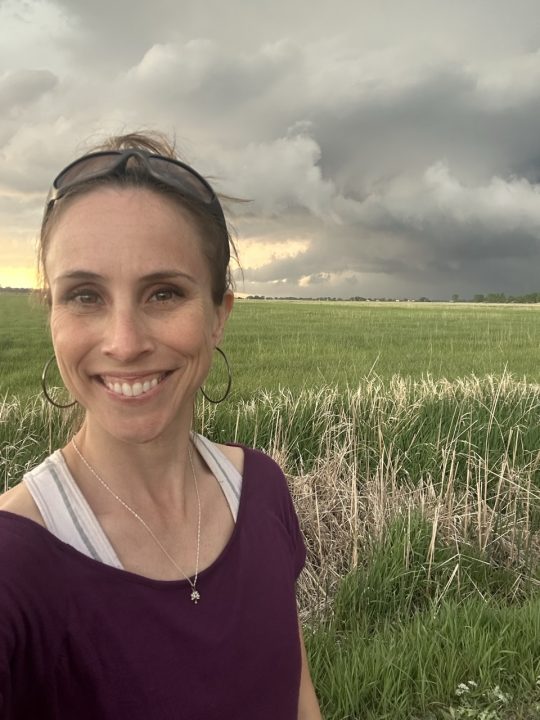
Jana Houser, Ph.D., is an associate professor of meteorology and has made a career of studying tornadoes.
Jana Houser, Ph.D., associate professor of meteorology at The Ohio State University, has spent much of her career studying severe thunderstorms and tornadoes. Using mobile radar systems and field research, Houser and her colleagues chase storms across the country to better understand how tornadoes form, evolve, and respond to factors.… Continue reading
The Livestock Conservancy, a national not-for-profit organization dedicated to the conservation, protection and promotion of rare agricultural breeds in the United States, has released its 2026 Conservation Priority List. This roster of more than 180 breeds across 11 species ranks the extinction threat for America’s farm animals. In 2026, two formerly endangered breeds graduated from the list – Belgian Horses and Silver Fox Rabbits.
In this video, Ohio Ag Net’s Joel Penhorwood talks with Alison Martin, program director for The Livestock Conservancy about the news and their ongoing work.… Continue reading
A late-March tornado swept through parts of the Hardin County Fairgrounds. In its wake were broken buildings, missing roofs, and the question of what lies ahead. In this video, Ohio Ag Net’s Joel Penhorwood hears from Hardin County Fair Marketing and Communication Director Kolt Buchenroth about for an in-depth look at the damage and their plans for the upcoming fair just five months away.… Continue reading
By Kevin J. Jacque, DVM, PAS – Clinical Assistant Professor, OSU Large Animal Services at Marysville
In 2021, the FDA provided a guidance document and timeline for the removal of medically important antimicrobial products from over-the-counter status to prescription status (OTC to Rx). This guidance was titled GFI 263, “Recommendations for Sponsors of Medically Important Antimicrobial Drugs Approved for Use in Animals to Voluntarily Bring Under Veterinary Oversight All Products That Continue to be Available Over-the-Counter Guidance for Industry.” This governmental issue was officially started in practice in June 2023 which allowed for the removal of products like penicillin, oxytetracycline, sulfa antibiotics, tylosin, lincomycin, and mastitis intramammary tubes. Most of you may remember not being able to buy Penicillin or LA200 at the farm store after a while (once current stocks were depleted from inventory). This may have caused some stress to farm animal owners, but many notices were sent.… Continue reading
It is sometimes funny how my Food for Thought column topics evolve. Last week, while I tagged along with Paul at a dairy producer conference, Lois, an Ohio farm wife, asked me if I had tried sweetpotato and brisket hash. My cover had been blown, and Lois had found out my intel earlier in the day. She asked me to find this recipe and share it with all of you. I laughed and responded, “I’ll see what I can do.” As we headed home, I was scrolling through Instagram when an amazing twist on baked sweetpotatoes popped up. They looked like caramelized deliciousness, almost like a sweetpotato Brule. Then, to top it off, I was chatting this week with a fellow foodie friend, Kristi. “Is there any interesting food trends going on?” Kristi told me to check out an influencer named Courtney Cook (@courtneycookinsta). She does these crazy things with sweetpotatoes.… Continue reading
The Ottawa County Farm Bureau recently hosted their annual Legislative Lunch at the farm of Sheldon Miller. Ohio Ag Net’s Dusty Sonnenberg was there and caught up with some of the speakers from the event about some of the topics at hand, including property taxes, data centers and the upcoming planting season.… Continue reading
By Dusty Sonnenberg, CCA, Field Leader, a project of the Ohio Soybean Council and soybean checkoff
With the calendar turning to April, early soybean planting is on the minds of many growers across the Buckeye State. Recent rainfall has left soil conditions in many areas less than favorable; however, soil temperatures have gradually increased in recent days. Alex Lindsey, Ph.D., of The Ohio State University, and Taylor Dill, director of research for the Ohio Soybean Council, recently discussed considerations for early soybean planting.
Dill conducted her Ph.D. research as part of the Battle for the Belt, focusing on planting dates.
“I investigated early planting dates, and the results we have been seeing show that you can plant soybeans pretty early in most of the state and not only optimize yield with earlier planting dates, but also, from a profitability standpoint, in the past three years, the greatest likelihood of being profitable was with our early planting dates,” Dill said.… Continue reading
Cooper Farms and Weaver Eggs each donated 108,000 eggs to Greater Cleveland Food Bank as part of the Great American Egg Drive, a nationwide effort bringing egg farmers together to support communities ahead of Easter and Passover — and one of the largest egg donation efforts ever.
The donation will provide fresh, nutritious, high-quality protein to individuals and families across the northeast Ohio region. Eggs will be distributed through Greater Cleveland Food Bank’s network of partner agencies across six counties: Cuyahoga, Ashland, Ashtabula, Geauga, Lake, and Richland.
“We take pride not only in producing food, but also in giving back,” said Alex Weaver, president, Weaver Eggs. “Being part of an effort that brings egg farmers together to support communities across the country means a great deal to us.”
The American Egg Board, on behalf of America’s egg farmers, is leading the Great American Egg Drive — bringing farmers together to give back in communities nationwide during a time of year when eggs play an important role in meals and traditions.… Continue reading
In the first USDA Crop Progress Report of the season, few numbers are on the board for Ohio with the exception of winter wheat ratings and oats. Ohio winter wheat is 1% very poor, 2% poor, 34% fair, 54% good, and 9% excellent. 5% of Ohio’s oats are planted, slightly behind the 7% five-year-average.
Nationally, 3% of the corn crop is planted and 28% of oats are in the ground.
Ohio topsoil moisture is 3% short, 54% adequate, and 43% surplus. Subsoil moisture is noted as 2% very short, 15% short, 68% adequate, and 15% surplus.
 Ohio Ag Net | Ohio's Country Journal Ohio Ag Net | Ohio's Country Journal