 Ohio Ag Net | Ohio's Country Journal Ohio Ag Net | Ohio's Country Journal
Today’s report was bearish for corn, soybeans, and wheat. All three had an ending stocks increase that were greater than expected.
Corn production was estimated at 13.654 billion bushels, up 99 million bushels from last month. The yield was set at 169.3 bushels per acre, up from last month at 168. Corn exports were lowered 50 million bushels. The trade had expected exports to decline 25 million bushels. Corn ending stocks were pegged at 1.760 billion bushels, an increase of 199 million bushels.
Soybean production was estimated at 3.981 billion bushels. Last month it was 3.888 billion bushels. The yield was increased to 48.3, up from last month at 47.2. Ending stocks were estimated at 465 million bushels. Soybean exports were increased 40 million bushels and the crush went up 10 million bushels. The higher demand was not enough to offset higher production. Both corn and soybeans had no changes to planted and harvested acres.
Wheat ending stocks were 911 million bushels, up 50 million bushels.
Shortly after the report release corn was down 4 cents, soybeans down 10 cents, with wheat down 7 cents.
Traders were expecting USDA to increase both corn and soybean production for the 2015 growing season. In addition, ending stocks were expected to increase for corn, soybeans, and wheat.
Grains have been on the defensive since the Oct. 9 USDA crop report. That day December CBOT corn closed at $3.8275, down 8.5 cents for the day. January CBOT soybeans ended the day at $8.905, up 4 cents that day. December CBOT wheat on the October report day settled at $5.0925, down 2 cents. Harvest progress that week had corn at 42% while soybeans were 62% harvested. Harvest has progressed rapidly the past month and is nearly complete. The harvest progress numbers from yesterday had the US corn harvest at 93% with the soybean harvest at 95%.
Prior to the report release, December CBOT corn was trading at $3.64, down 3 cents while January CBOT soybeans were at $8.61, down 5 cents. December CBOT wheat was $4.94, down 8 cents.
Corn has been close to the magical $4 mark this harvest season when it reached $3.9975 on October 7. It has not been able to retest those levels with the daily high only able to reach $3.875 since the October report. Export demand for corn has been weak with the start of the marketing year on September 1st. Corn exports this past week were a paltry 11.6 million bushels. In previous harvest seasons, corn exports have typically have seen a weekly range of 35-50 million bushels. Not so this year. Take a look at the weekly export table for corn, soybeans, and wheat export loadings since Sept. 1 that is detailed below:
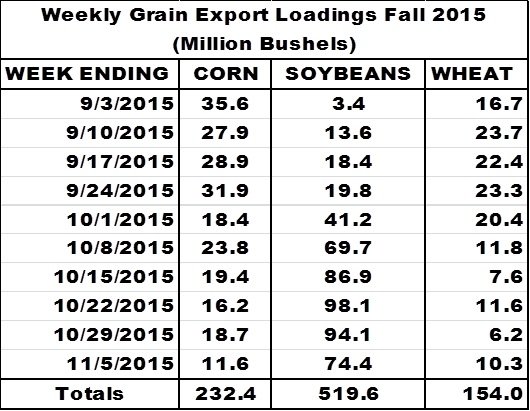
Three things are quickly apparent from this table. First, soybean exports exceed corn and wheat combined. Second, soybean exports are more than double those of corn. Third — this one is most glaring in its magnitude — soybean exports ramp up sharply during the last week of September with the report of Oct. 1. At the same time corn exports fall off sharply from previous weeks. Clearly there is a strong U.S. export push for soybeans this fall.
October shipments of U.S. soybeans to China reached 6.3 million tons, down from the record last year of 7.0 million tons. China’s appetite for soybeans continues to grow as it set a record for October inbound shipments of 9.2 million tons compared to last year’s 7.1 million tons.
Everyone knows that U.S. soybean exports will fall off dramatically as the harvest begins in Brazil and Argentina. The soybean export pace of the past six weeks is clearly not sustainable into next summer. Currently soybean export loadings are running 4% ahead of last year at this time. The same comparison shows corn exports are 25% behind last year, while wheat exports are 17% behind last year. We face strong corn export competition from South America. Wheat is up against competition from Russia and Australia. With both corn and wheat exports lagging those of last year, it is easy to see why corn and wheat have not been able to launch and sustain rallies the past three months.
The close today will be a huge event to monitor. That is because today’s low for December corn reached $3.58. The low since Aug. 1 has been $3.575. January soybeans have seen a low so far today at $8.525. The low prior to that and since August had been $8.57.
Traders had expected a negative report, they certainly had that come to fruition. Now to see what happens the next few days. The move lower this week will only strengthen the resolve of producers to keep the corn bins closed. Basis could have to do the work to get corn out of those bins between now and early January 2016.


