May 7, 2024 Market Analysis, Top Headlines

By Jon Scheve, Superior Feed Ingredients, LLC
Delays in planting across parts of the Corn Belt sparked a rally in corn last week. If a large portion of the crop isn’t planted over the next two weeks, futures could continue to rise. However, if there seems to be enough opportunity for farmers to make significant progress in planting, then the market will likely pull back.
Setting corn basis on the 2023 crop
I have 100% storage capacity for all my crop production on my farm. This helps with harvest logistics and allows me to maximize profitability from more basis opportunities and market carry.
Within 60 miles from my farm, there are two ethanol plants, six feed mills, and four rail shuttle loaders. Since I never know which location will have the best bid each year after harvest, HTA (Hedge To Arrive) contracts are never a profitable option. Usually, I can even get a premium to what my local markets are bidding, if I sell my corn picked up on the farm and let someone else haul it away, which can sometimes be up to 500 miles.… Continue reading
Read More » April 30, 2024 Market Analysis, Top Headlines
By Jon Scheve, Superior Feed Ingredients, LLC
Last week, basis and the spreads between futures contracts suggested that the market wanted grain now and not later. That prompted a question from a farmer who asked what they should do with the grain still in the bin. They told me they weren’t happy with the flat price value of grain, but they had time to move their grain while it was raining. They wanted to know if they should take advantage of free storage programs that their end user in their area was giving them and move their grain now.
I told them that if it were me, I would ABSOLUTELY NOT do that.
Why?
The whole reason the basis is improving, and the spread is narrowing, is because end users can’t get corn into their facility. Delivering corn into “free” storage programs only helps end users procure bushels when they are desperate.… Continue reading
Read More » April 23, 2024 Market Analysis, Top Headlines
By Jon Scheve, Superior Feed Ingredients, LLC
Many U.S. farmers are not selling grain at current low prices. The reason might be because so many farmers have a breakeven for the 2023 corn crop above $5. It seems likely the farmer does not want to sell corn at cash values below $4.50 before they plant next year’s crop.
This has contributed to the May/July corn futures spread narrowing from a 14-cent carry two weeks ago to a 9-cent carry this week. The reason the spread would narrow is because there is demand from the export market for cash corn along the Mississippi and Illinois river when farmer selling is light.
That spread change may mean little to farmers, but to those who profit from storing grain, it is more than a 30% drop in potential revenue over the next two months. Additionally, the basis has had at least a 10-cent increase in the western Corn Belt over the last few weeks.… Continue reading
Read More » April 17, 2024 Market Analysis, Top Headlines

By Bernt Nelson, American Farm Bureau economist
Cold storage, particularly for red meat and poultry, is an important part of the protein supply chain, with meat in cold storage coming from a variety of sources and used in both domestic and global markets. USDA’s monthly Cold Storage report measures reserve food supplies held in commercial and public warehouses. All stocks in the March 25 report represent inventory in cold storage on Feb. 29, 2024. Red meat in freezers was estimated to be 1.05 billion pounds, down 4% from February 2023 and the lowest it has been in 23 years. Frozen poultry stocks, a separate measure from red meat, were 1.03 billion pounds in February 2024, down just 1% from last year. These changes were somewhat expected since nearly all animal protein sectors are experiencing or will experience lower inventories in 2024 and beyond. When the supply of any commodity falls, it’s common for market volatility to increase.… Continue reading
Read More » April 15, 2024 Market Analysis, Top Headlines

By Doug Tenney, Leist Mercantile
While cycling sold recently in North Carolina in what I deemed to be familiar territory, I (oops) “left the planned route.” Realizing my phone showed 10% battery life and that I was lost was not my most shining moment. My new navigation means became a conversation with a DoorDash driver, a local fire department, and a nice lady working in her yard. Fortunately, I was just 5 miles short of my destination. Since I had alerted Cindy of my dilemma, she once again got to “wonder” as I “wandered.” No need to worry, just wait. The same advice followed by producers, prepared and anxious to plant.
Puzzling and perplexing accurately describes the situation of soybean trading activity on Friday, April 12. Literally out of nowhere, soybeans mid-morning were up 20 cents, and closing up 14 cents. Numerous research reports literally had no explanation of what was taking place and were unable to put forth fundamental reasons for the rally.… Continue reading
Read More » April 11, 2024 Market Analysis, Top Headlines

By Bennett Musselman, Leist Mercantile
Trade expectations: U.S. soybean exports reduced, increased ethanol demand and Brazil soybean and corn production to be reduced.
Following the noon USDA report release, corn was down 2 cents, soybeans down 12 cents, and wheat down 9 cents. Moments before the report was released, corn was down 1 ½ cents, soybeans down 8 cents, and wheat down 6 cents.
U.S. 2023-2024 ending stocks: corn 2.122 billion bushels, last month 2.172 billion bushels; soybeans 340 million bushels, last month 315 million bushels; and wheat 698 million bushels, last month 673 million bushels.
Trader estimates for 2023-2024 US ending stocks: corn 2.102 billion bushels; soybeans 317 million bushels; and wheat 690 million bushels.
Surprisingly there were no changes Brazilian soybean production. The trade was anticipating a slight reduction in the Brazilian soybean crop. USDA this month estimates Brazil soybean production at 155 million tons, last month was 155 million tons.… Continue reading
Read More » April 9, 2024 Market Analysis, Top Headlines
By Jon Scheve, Superior Feed Ingredients, LLC
History repeated itself again this week. Just like the last 10 years, May corn futures finished lower than the close one week after the March planting intentions was released.
Where will prices go from here?
In 2016, 2021, and 2022 the price of May corn rallied over the next 3 weeks. In 2021 and 2022, old crop corn carryout was very tight. However, in 2016 as is the case this year the stocks are not tight.
In 3 of the last 10 years, May corn’s value at the end of April was similar to or a few cents higher compared to the value of corn at the beginning of April. And in the other 4 of the last 10 years, corn finished the month lower than where it started. So, based on historical trends, there is a good chance May corn will not finish the month much higher and could end up even lower. … Continue reading
Read More » April 4, 2024 Market Analysis, Top Headlines

By Doug Tenney, Leist Mercantile
Recently, I was doing some cleaning with a small stiff brush. Watching me, Cindy suggested a toothbrush might do a more thorough job unless I wanted to keep blundering along. Here’s to zero blunders in the weeks ahead as the planting of corn and soybeans take place now and into May. Be safe in those long days with no unforeseen brushes with trouble.
The March 28 USDA report of US Quarterly Grain Stocks, along with U.S. Prospective Plantings provided a huge bullish surprise for corn. U.S. corn acres for 2024 were estimated at 90.0 million acres. Last year was 94.6 million acres, a decline of 5%. Trader estimates for corn were 91.8 million acres. In addition, U.S. corn stocks were estimated at 8.350 billion bushels, 95 million bushels below trader estimates. Soybean acres were estimated at 86.5 million acres, up 4% from last year. The combination of corn acres and corn stocks below trade expectations were much welcomed by Ohio and U.S.… Continue reading
Read More » April 2, 2024 Market Analysis, Top Headlines
By Jon Scheve, Superior Feed Ingredients, LLC
Of the 15 reports put out by the USDA each year the March planting intentions report is arguably the fourth or fifth most anticipated report of the year.
For corn the USDA surprised the market by dropping planting intentions to 90 million acres which is 1 million acres below what the Economic Forum printed in the middle of February. In the last 17 years the number of planted acres posted in the June report was higher than the intended acres of the March report 9 times. On average the amount of increase in acres to the June report was around 1 million acres.
Where do prices go now?
In the last 10 years the price of May corn on report day has moved up or down more than 20 cents only 1 time. In 8 of the last 10 years, the price of May corn the week after the report was trading in the opposite direction from the starting point it traded on report day.… Continue reading
Read More » March 31, 2024 Market Analysis, Top Headlines

By Doug Tenney, Leist Mercantile
Following a great dinner at home recently, Cindy asked, “So, Doug, if you were preparing tomorrow night’s meal, what would you make?” Hmn…My response, “Remember that time I made a baloney omelet?” I was immediately disqualified. Producing a meal requires skill, planning, experience, and common sense — just like producing crops. No baloney about that!
Recent price activity for CBOT wheat has been extremely disappointing. During the first half of December 2023, July CBOT rallied to $6.66 in the midst of a 3-day buying spree when China bought 41 million bushels of US wheat. Fast forward to the week of March 11. Disappointment was plentiful when in 3 successive days China announced several cancelations of U.S. wheat purchases totaling 18 million bushels. That same week China was also canceling wheat purchases from Australia and France. Corn, soybeans, and wheat all took huge price declines from December into February.… Continue reading
Read More » March 28, 2024 Market Analysis, Top Headlines
By Doug Tenney, Leist Mercantile
U.S. corn acres were a surprise at the decline.
Have a safe weekend as your families gather to celebrate Easter in numerous family traditions.
One point to remember today. Rarely are both corn and soybean acres bullish or bearish. In addition, today marks the end of the week, end of the month, and end of the quarter.
USDA today released two reports, U.S. Prospective Plantings and U.S. Grain Stocks as of March 1. Those two reports detail U.S. numbers only.
Following the noon USDA report release, corn up 12 cents, soybeans up 2 cents, and wheat up 8 cents. Just before the report was released, corn was unchanged, soybeans down 12 cents, and wheat up 4 cents.
U.S. corn 90.0 million acres, last year 94.6 million acres. U.S. soybeans 86.5 million acres, last year 83.6 million acres. U.S. wheat 47.5 million acres, last year 49.6 million acres.… Continue reading
Read More » March 19, 2024 Market Analysis, Top Headlines
By Jon Scheve, Superior Feed Ingredients, LLC
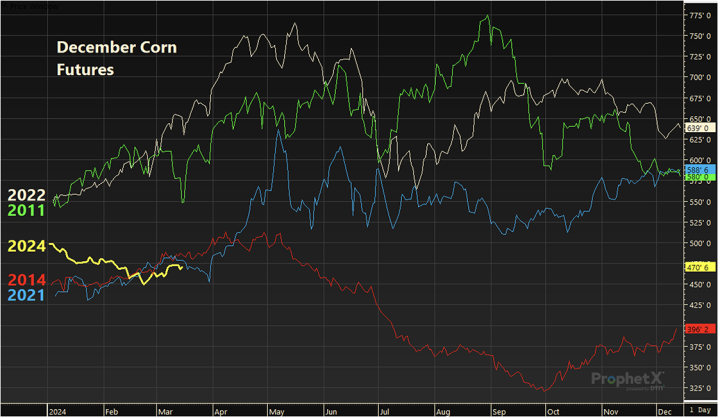
Some market participants are saying the near-term lows for corn may be behind us for now. They point to this recent 30-cent corn rally, after two months of significant price decline, as evidence. They go on to say corn could rally further into spring from weather issues, plus there is a 30-year average trend that shows corn usually rallies from March into June.
While I hope these predictions are right, I’m concerned that they may not be. The following charts compare December 2024 corn futures prices for the calendar year so far to other marketing years.
Years with tight carryout — Higher prices were necessary to ration demand
So far, 2024 is not behaving like the years in this chart. This could be because there is a large carryout right now, unlike the other years in this group.
Years with large carryout — December prices started much lower than where it is currently trading
The marketing years of 2016, 2017, and 2018 followed years with large carryout and had above trendline yields.… Continue reading
Read More » March 12, 2024 Market Analysis, Top Headlines

By Jon Scheve, Superior Feed Ingredients, LLC
Crop insurance is a great tool to protect a farmer’s production risk. It guarantees that if something happens during the growing season, the farmer is protected from catastrophic losses.
However, some farmers think their revenue protection crop insurance is providing a floor price for their grain that protects them against falling crop prices. I believe that is an incorrect thought process and I think that crop insurance should be thought of as a revenue protection tool. This is because it considers both price and production in its calculations. Let me explain.
First, some farmers believe their revenue protection price is guaranteed at the spring value, which is $4.66 this year. Unfortunately, it is not. The revenue protection is based on the level of insurance farmers buy. If a farmer elects to buy the highest level of coverage, they can only get 85% coverage. If we use that coverage value as the example this means the price value of the floor protection is actually $3.96 ($4.66 spring value x 85% coverage).… Continue reading
Read More » March 8, 2024 Market Analysis, Top Headlines

By Doug Tenney, Leist Mercantile
Report highlights: U.S. corn exports and ethanol unchanged. U.S. soybean exports and crush unchanged. Brazil soybean production down just 1 million tons.
Trade expectations: U.S. soybean exports to decline, U.S. corn for ethanol to increase. Brazil soybean and corn production to decline.
Following the noon USDA report release, corn down 1 cent, soybeans down 2 cents, and wheat up 6 cents. Just before the report was released, corn down 3 cents, soybeans down 6 cents, and wheat up 7 cents.
U.S. 2023-2024 ending stocks: corn 2.172 billion bushels, last month 2.172 billion bushels; soybeans 315 million bushels, last month 315 million bushels; and wheat 673 million bushels, last month 658 million bushels.
USDA this month estimates Brazil soybean production at 155 million tons, last month was 156 million tons. Brazil corn production was estimated at 124 million tons, last month was 124 million tons. Argentina soybean production was 50 million tons, last month was 50 million tons.… Continue reading
Read More » March 6, 2024 Market Analysis, Top Headlines
By Doug Tenney, Leist Mercantile
“Eenie meenie miney mo, who shall stay and who should go? How are we supposed to know? Eenie meeine miney mo” was Cindy’s response to one more political mailing for a mud-slinging local race. The same question could be asked by U.S. producers in relation to corn acres, “Which way do we go?” Corn prices are down more than soybean prices compared to last February.
The USDA Outlook Forum on February 15 and Feb. 16 estimated U.S. 2024 corn acres would be 91.0 million acres, down from last year at 94.6 million acres. Meanwhile, U.S. 2024 soybeans were estimated to reach 87.5 million acres compared to last year at 83.6 million acres. While some minor changes could take place for corn and soybean acres this year, don’t expect multiple millions of acres changes in 2024. Why? U.S. producers are creatures of habits, one being crop rotation is an annual event.… Continue reading
Read More » March 5, 2024 Market Analysis, Top Headlines
By Jon Scheve, Superior Feed Ingredients, LLC
The soybean market has lost nearly $3 per bushel in value from early November. Most of this steep decline is due to South America’s crop getting bigger and worldwide demand not increasing at the same speed. There are some in the trade expecting bean prices to rebound.
Several South American crop watchers are reporting that yields there are shrinking due to dry weather during the growing season. However, these groups may not be taking into consideration that overall planted acres may have increased significantly compared to last year, which could have offset much of the yield losses.
Also, some market participants think the current reported USDA’s crop size of South America is higher than it should be. They point to CONAB, Brazil’s equivalent to the USDA, lowering their yield estimates the past few months to a total production under 150 Million Metric Tons (MMT).… Continue reading
Read More » February 27, 2024 Market Analysis, Top Headlines

By Jon Scheve, Superior Feed Ingredients, LLC
If you are unsold or unprotected, the markets have been hard to watch. This has led many market participants to talk about how funds are short a record level of contracts. These groups seem to believe the funds will begin covering their shorts soon and the market could then rally 20 to 50 cents.
How likely is this?
For a big rally to happen there will need to be a spark to ignite it. This would mean either a demand increase or a supply problem somewhere in the world.
How likely is a demand increase?
Demand increases are usually slow to develop and often take longer than a year to gain traction. For example, the soy crushing plants expanding to make renewable energy throughout the U.S. may work, because it would require more bean acres, which could eventually help corn prices. However, many of these additional plants are not scheduled to be up and running for 18 months to 2 years.… Continue reading
Read More » February 26, 2024 Market Analysis, Top Headlines
By Doug Tenney, Leist Mercantile
Last month Cindy and I were talking about the upcoming solar eclipse as Ohio will be one of several states to experience the event. I mentioned to the need for some type of eye protection, more than sunglasses, perhaps even a welding helmet would be needed. She asked, “What’s a “Wally Helmet?” I slowly spelled, “w-e-l-d-i-n-g helmet.” I guess I talk too fast. The partial or total eclipse will traverse Ohio in a line from west of Cleveland and southwest to Greenville beginning at 1:59 pm that afternoon. Just like the proper equipment will be essential, it will be necessary to relay exact information at precise times in preparation for the spring planting season to be termed a success. At any rate, she’s still teasing me about my Wally helmet.
Ohio’s producers have until March 15 to make their final decisions on their crop insurance coverages for 2024 corn and soybeans.… Continue reading
Read More » February 8, 2024 Market Analysis, Top Headlines

By Doug Tenney, Leist Mercantile
U.S. highlights — Few changes were expected. U.S. soybean exports were lowered 35 million bushels, more than expected. The Brazil soybean production was down, but not as much as expected.
Trade expectations: U.S. soybean exports reduced, Brazil soybean and corn production to be reduced.
Following the noon USDA report release, corn was down 2 cents, soybeans 2 cents, and wheat down 11 cents. Moments before the report was released, corn was down 2 cents, soybeans up 11 cents, and wheat down 13 cents.
U.S. 2023-2024 ending stocks: corn 2.172 billion bushels, last month 2.162 billion bushels; soybeans 315 million bushels, last month 280 million bushels; and wheat 658 million bushels, last month 647 million bushels.
Trader estimates for 2023-2024 US ending stocks: corn 2.152 billion bushels; soybeans 243 million bushels; and wheat 684 million bushels.
USDA this month estimates Brazil soybean production at 156 million tons, last month was 157 million tons.… Continue reading
Read More » February 7, 2024 Market Analysis, Top Headlines
By Doug Tenney, Leist Mercantile
Last month Cindy and I were at a local restaurant. I asked, “See anyone you know?” Her response, “I know you.” Since waiting isn’t one of my gifts, she suggested I take a walk among the tables because I always find at least one familiar face. For once I had no success. Here’s hoping your efforts to secure needed workers as well as getting equipment field ready for preparation and planting does not come up as empty.
Grain prices to start the New Year were not friendly as they continued their downward trend and moved even lower for the first month of 2024. In January, corn was down 23 cents, soybeans down 76 cents, and wheat down 33 cents. Fundamentals are sorely lacking at this juncture for 2024 as producers come to grips with a lots of doom and gloom for grains. Money flow, demand, and world grain supplies are the main drivers as we move further into 2024.… Continue reading
Read More » Ohio Ag Net | Ohio's Country Journal Ohio Ag Net | Ohio's Country Journal