Ohio Ag Net | Ohio's Country Journal Ohio Ag Net | Ohio's Country Journal
By Jon Scheve, Superior Feed Ingredients, LLC
If you are unsold or unprotected, the markets have been hard to watch. This has led many market participants to talk about how funds are short a record level of contracts. These groups seem to believe the funds will begin covering their shorts soon and the market could then rally 20 to 50 cents.
How likely is this?
For a big rally to happen there will need to be a spark to ignite it. This would mean either a demand increase or a supply problem somewhere in the world.
How likely is a demand increase?
Demand increases are usually slow to develop and often take longer than a year to gain traction. For example, the soy crushing plants expanding to make renewable energy throughout the U.S. may work, because it would require more bean acres, which could eventually help corn prices. However, many of these additional plants are not scheduled to be up and running for 18 months to 2 years.
How likely is a supply problem?
Droughts and planting delays in the U.S. or other major corn producing countries could impact supply. Argentina’s corn crop is in the reproductive stage and appears to be in good shape for now. Brazil is currently planting their second corn crop, so weather could impact production there in about 2 months. Here in the U.S., a wet spring in late April or a summer drought in July could also impact supply.
Could the funds short the market more and send prices even lower?
Before 2013, funds never really put much of a short position on (see the yellow line in the chart below).
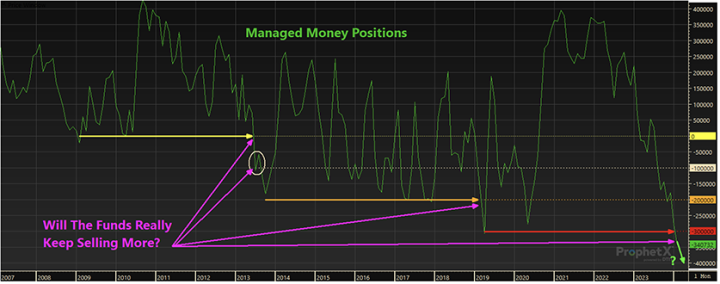
However, in 2013 crop conditions were improving and carryout was increasing, which led to the funds to put on their first sizeable short position of -100,000 contracts. Many thought this would be the limit of their short position, but after a slight correction they pushed it to -200,000 contracts, but never went below that for another 5 years. Then in 2019 funds pushed their short position to -300,000 contacts.
Each time funds hit a new record short position, some market participants say the short can’t get bigger, but then it does. It is possible funds may look at the global corn supply and go to -400,000 contracts. After all, they have been long nearly +400,000 contacts several times in the last 15 years.
Possible reason why many U.S. farmers are undersold on their 2023 crop
Many farmers set basis against March futures, expecting a rally during the winter. However, now due to cashflow issues, they might be backed into a corner and could price some grain in the next week or so.
The following chart shows the commercial position, which is widely considered to be famers’ collective position.
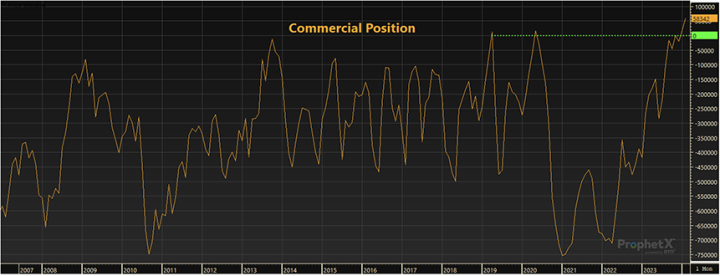
As the farmer sells the grain the commercial sells futures against that trade. Thus, it would be a bit strange for the commercial to be long, and since the ethanol mandate 17 years ago, commercials have usually never been overly long. But this week we found that they are.
The managed money funds are likely looking at this same chart and know farmers must eventually sell their grain before the next crop year. So, they may be sitting back and waiting for it to eventually happen, because they believe that time is on their side.
How low can corn go?
Historically, whenever the carryout and stocks to use ratio has been this big the value of corn at some point after harvest has seen the May or July contracts trade below $3.60.
The market is looking for a way to shrink supply and discourage plantings in Brazil’s second crop or change a few acres away from corn in the U.S. this spring.
Some in the trade are predicting $3 futures are imminent, but that seems like a stretch with what we know today. Even in 2020 when the world shut down, corn never traded below $3. It’s important to remember that things always look the darkest right before the dawn, and low prices can also spur demand.
It only takes one surprise to change the market’s perception and direction. The cure to low prices, is low prices.
Please email jon@superiorfeed.com with any questions or to learn more. Jon grew up raising corn and soybeans on a farm near Beatrice, Neb. Upon graduation from The University of Nebraska in Lincoln, he became a grain merchandiser and has been trading corn, soybeans and other grains for the last 18 years, building relationships with end-users in the process. After successfully marketing his father’s grain and getting his MBA, 10 years ago he started helping farmer clients market their grain based upon his principals of farmer education, reducing risk, understanding storage potential and using basis strategy to maximize individual farm operation profits. A big believer in farmer education of futures trading, Jon writes a weekly commentary to farmers interested in learning more and growing their farm operations.
Trading of futures, options, swaps and other derivatives is risky and is not suitable for all persons. All of these investment products are leveraged, and you can lose more than your initial deposit. Each investment product is offered only to and from jurisdictions where solicitation and sale are lawful, and in accordance with applicable laws and regulations in such jurisdiction. The information provided here should not be relied upon as a substitute for independent research before making your investment decisions. Superior Feed Ingredients, LLC is merely providing this information for your general information and the information does not take into account any particular individual’s investment objectives, financial situation, or needs. All investors should obtain advice based on their unique situation before making any investment decision. The contents of this communication and any attachments are for informational purposes only and under no circumstances should they be construed as an offer to buy or sell, or a solicitation to buy or sell any future, option, swap or other derivative. The sources for the information and any opinions in this communication are believed to be reliable, but Superior Feed Ingredients, LLC does not warrant or guarantee the accuracy of such information or opinions. Superior Feed Ingredients, LLC and its principals and employees may take positions different from any positions described in this communication. Past results are not necessarily indicative of future results.