Ohio Ag Net | Ohio's Country Journal Ohio Ag Net | Ohio's Country Journal
By Mike Zuzolo, Global Commodity Analytics & Consulting LLC
Borrowing from a phrase in the 1990s about the economy: “It’s the grain demand, stupid.”
USDA confirmed in its August WASDE report continued tightening of supplies for both grains and cattle. Now the futures trade needs to come to grips with little, if any, demand rationing.
The headline story for the futures trade in USDA’s most recent monthly report was the reduced corn yield, in my view.
Just as important to me was the fact that USDA continued to increase U.S. corn exports in both the 2025-26 and 2026-27 marketing years. As a result of this, coupled with USDA increasing 2026-27 world corn exports, the world corn stocks-to-use ratio is now at a five-year low. The U.S. stocks-to-use ratio is also just 2% from matching the five-year low set back in 2022-23. See the Stocks/Use Matrix below.
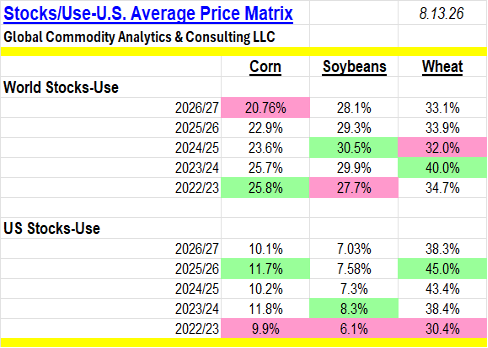
When viewing the numbers from this angle, it seems much clearer to me that the U.S. corn price, and to a lesser degree the U.S. wheat price, hasn’t gone high enough to ration demand. This is especially true given Northern Hemisphere weather problems that have caused French and Romanian corn prices to rise to around $7.75 and $6.50 per bushel, respectively. That compares with the U.S. Gulf price of approximately $5.50 per bushel at the time of this writing.
It seems to me that the corn producer and livestock feeder should be asking themselves: Does U.S. corn demand need to be rationed?
Ukraine’s corn exports
If the current European drought and heat wave migrates east into the Ukrainian Corn Belt, Ukrainian corn exports will likely be reduced, potentially sharply, in my estimation.
In its August WASDE, USDA officially lowered Ukraine’s 2026-27 corn exports by 1 million metric tons to 22 million metric tons. This came as USDA simultaneously raised Ukraine’s production by 1.8 million metric tons to 31.8 million, which, if realized, would be the highest in three years.
A few days before the WASDE report, USDA’s Foreign Agricultural Service update for Ukraine showed a similar but more extreme pattern. In the FAS attaché report, 2026-27 corn production was increased by 2.99 million metric tons, while exports were reduced by 9 million metric tons to 14 million.
This divergence in Ukraine’s supply and demand shows us very clearly, I think, just how difficult it is for official agencies to “see through” the geopolitical conflict that seems to be worsening every week in the Black Sea.
In fact, it seems to me that the worsening commodity-related issues facing the energy markets in the Persian Gulf, along with worsening conditions in the Black Sea for grains and oilseeds, are creating more confusion for the commodity sector as a whole when determining world supply-and-demand fundamentals.
As a result of this uncertainty, I think there is a growing likelihood that, if weather continues to turn hotter and drier in the Black Sea region, Ukraine’s exports will move lower due to the war and damage inflicted on infrastructure, shipping, etc. I also think Ukraine’s production could be reduced back closer to the 2024-25 level of around 27 million metric tons.
In this scenario, yes, I do think some demand rationing for U.S. corn could be needed since 2026-27 carryover is closer to 1.5 billion bushels than it is to 2 billion bushels.
Soybeans keep an eye on supply and demand
For soybeans, price determination is still about both supply and demand for the next 30 days.
The market has welcomed the continued buying of U.S. soybeans by China ahead of the mid-September state visit of President Xi to Washington. I think this has relieved some of the export demand concerns the commodity trade was starting to consider.
However, unlike corn, the improved rainfall pattern forecast between mid-August and mid-September could help soybeans attain higher yields, in my view. In this respect, soybeans have more potential to weaken as we move into September, especially late September if the U.S.-China trade relationship becomes more strained.
Will global fertilizer prices and positive biofuel policies encourage more 2027 soybean acres in both South America and the United States? That’s what I’m projecting in my forecasts currently.
Summer grilling season demand
Cattle and hogs could feel futures pressure from the demand side with the end of summer grilling season and higher fuel prices, but cash markets continue to see supplies tighten into the fourth quarter.
Given the drought and extreme heat in feedlot country since July, and given USDA reducing both third- and fourth-quarter beef production numbers in its August WASDE report, I continue to suggest to clients and subscribers that, like corn and wheat, potential downside price pressure could come more from futures and the “funds” versus the cash market.
As I write this, more beef slaughter capacity is being shuttered. This, I think, supports my mindset as we contend with a truly historic, and sad, situation in the U.S. cattle herd.
Disclaimer: There is significant risk of loss in trading futures and options on futures, and they may not be suitable for all investors. Investors should consider the risks involved and evaluate their suitability based upon their financial conditions. Past performance is not indicative of future results.
Mike Zuzolo has been a licensed Series 3 broker and analyst in commodities since 1995 and is the founder of Global Commodity Analytics & Consulting LLC. A native of Preble County, Ohio, Mike and his family have lived in northeast Kansas since 2013. Sign up for a four-week free trial of Mike’s analysis at globalcommresearch.com.