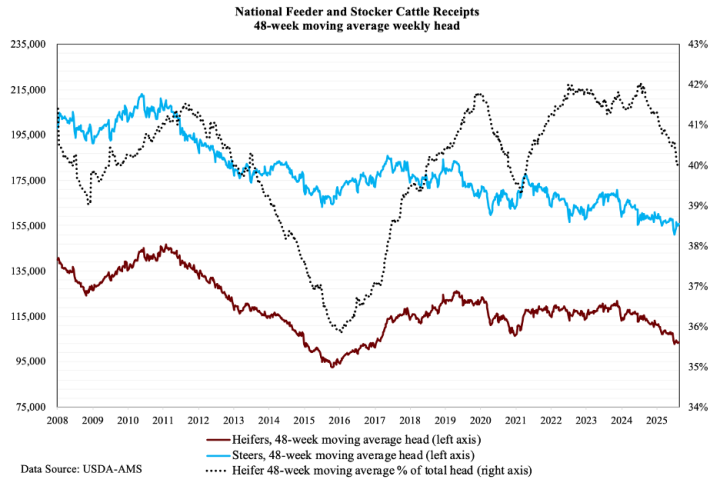
By Josh Maples, Mississippi State University Extension USDA-AMS reports the National Feeder and Stocker Cattle Summary each week. Feeder and stocker receipts in this data series averaged 255,941 head during the first eight months of 2025. This is 7.6 percent below the average for the same period in 2024 and 10 percent below the 2020-2023 average for January-August. These changes illustrate the tightening supplies of feeder and stocker cattle.
The chart above shows a different approach to analyze receipt patterns over time. The data are weekly; but instead of the current week’s total, the solid lines represent the weekly average for the prior 48 weeks. I used 48 weeks because this is usually the same as one year due to holiday weeks with no reports. For example, the most recent point on the chart (the week of August 22, 2025) represents the average weekly sales from September 2024 to August 2025.… Continue reading
The September World Agricultural Supply and Demand Estimates Report today included farm surveys along with soybean pod counts and corn ear weights. A few key points: •Brazil corn production up 3 million tons. • U.S. harvested corn acres up 1.3 million acres. • U.S. corn exports up 100 million bushels, ethanol unchanged. • U.S. soybean exports cut 20 million bushels, soybean crush up 15 million bushels. • U.S. corn production was pegged at 16.814 billion bushels, up from 16.742 billion last month and above the trade estimate of 16.516 billion. • U.S. soybean production was estimated at 4.301 billion bushels, compared to 4.292 billion last month and 4.271 billion bushels expected by traders. • U.S. corn yield was 186.7 bushels per acre, slightly below last month’s 188.8 but just above the 186.2 trader estimate. • U.S. soybean yield was 53.5 bushels per acre, compared to 53.6 last month and the 53.3 trade estimate.… Continue reading
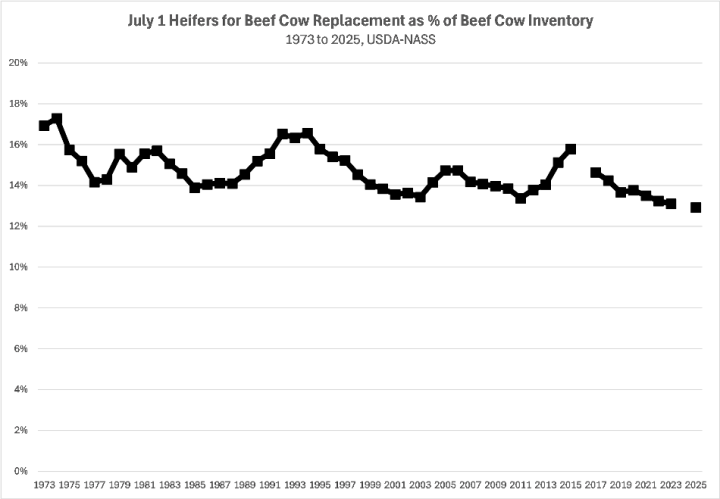
Heifers, as a percentage of on-feed inventory, were estimated at 38.1% in the July Cattle-on-Feed report. This is not a number that suggests widespread retention. The number of heifers held for beef cow replacement in the mid-year inventory report was estimated at 3.7 million head, a decrease of 100,000 heifers from July 1, 2023. I wanted to dig into that number a little deeper and frame it a bit with the ongoing discussion of beef cow slaughter.
I prefer to think about beef heifer retention as a percentage of beef cow inventory. A higher percentage suggests expansion of beef cow numbers is likely in the future and a smaller percentage suggests the opposite. As a percentage of estimated July 1 beef cow inventory, heifers held for beef cow replacement came in at 12.9%. That was down slightly from two years ago and is the smallest percentage in the mid-year dataset, which goes back to 1973.… Continue reading
Last month I went on a morning bike ride with Roger, as I have done dozens of times in past years. We navigated closed roads in Fairfield County as one road north of Lancaster had four culvert washouts due to the heavy rains of Sunday, July 27. Our bike ride had a welcome sighting of at least six golden yellow finches, which forged ahead of us for at least a mile. I also thought my phone was in the pocket of my cycling jersey but quickly realized it was not there in the first mile of our ride. I thought it odd that I did not find my phone in my truck upon our return. So, I did what all of us had done, I used another phone to call myself. However, this time there was a voice on the other end. That was indeed the weirdest of feelings; it was a fireman at a Fairfield County township firehouse who answered.… Continue reading
Earlier this month, I had the opportunity to attend the Ohio Ag Hall of Fame Breakfast. Each year, four individuals are inducted into the Ohio Ag Hall of Fame. This annual event took place during the Ohio State Fair. It is a huge gathering of hundreds of individuals across Ohio who engage in agriculture in many capacities. It includes those who are executive directors from Ohio’s agricultural trade groups, OSU Extension and county educators, and many more in between. It even included Ohio’s governor, Mike DeWine, and the president of The Ohio State University, Ted Carter.
At this event, Governor DeWine announced that the Ohio Legislature has provided additional funds for the veterinary program at The Ohio State University. The number of students accepted each year into its veterinary programs will be increasing. We all know about the steep academic curve and its high bar, which requires each student to be stellar.… Continue reading
Ohio farmers and landowners can expect cropland values and cash rents to continue inching upward in 2025, according to the latest study by Ohio State University Extension. While increases aren’t dramatic, they reflect ongoing economic adjustments in the face of tighter profit margins, elevated property taxes, and evolving interest rates.
The annual “Western Ohio Cropland Values and Cash Rents” study surveyed 145 individuals involved in agriculture, including farmers, landowners, lenders, and Extension professionals, from January to April 2025. Respondents offered estimates based on actual rental rates and land sales for three land classes: top, average, and bottom quality cropland.
Across western Ohio, cropland values are expected to rise by 0.6% to 4.1% depending on region and land quality. The survey analyzed the entire Western part of the state but also looked at regional differences.
Average cropland pricing is projected to increase 2.2%, from $11,604 per acre in 2024 to $11,856 in 2025.… Continue reading
The August WASDE Report (supply and demand) has a history of being volatile as we are now well into the growing season and have a better handle on corn and soybean production for 2025. With increased corn acres this year along with an increasing yield, US corn production could be a record this year with the potential of reaching 16 billion bushels a real threat.
After the report was released, corn was down 11 cents, soybeans up 3 cents, and wheat down 10 cents. Prior to the noon report, corn was down 5 cents, soybeans down 14 cents, and wheat down 6 cents.
US ending stocks for the 2024-25 marketing year: US corn ending stocks were 1.305 billion bushels, down 35 million bushels, last month 1.34 billion bushels, and the average trade estimate was 1.321 billion bushels. US soybean ending stocks were 330 million bushels, last month was 350 million bushels, with the average trade estimate 345 million bushels.… Continue reading
Last month, I was part of an 80-cyclist group and received a lot of support on the Lakeside 120 as we cycled from Delaware, Ohio, to Lakeside, Ohio, covering 120 miles. Several of my cycling friends have been on this bike ride in past years and encouraged me to do it this year. Another friend, Chris, from my Monday night Lancaster group ride was also on the huge ride to Lake Erie. Early in the day, Chris and I were chatting as he detailed the workings of his 10-minute timer on his cell phone. It reminded him to drink water consistently throughout the bike ride. A few hours later, Chris and I were not always side by side, yet we were still calling out to each other, “Drink Doug” or “Drink Chris,” when the timer went off. Several cyclists soon teased Chris, asking why a timer would be needed.… Continue reading
I have been a long-time watcher of NCIS and even more so with its ongoing reruns available on numerous outlets. It’s a long-held tradition by the four Tenney brothers to be rabid NCIS fans. I easily fit that mold, even as the youngest brother. A recent rerun marathon had Gibbs praising Tony for his excellent investigative techniques in a delicate and sensitive case, saying, “You may question his methods, but you gotta love the results.”
Hopefully, similar methods and skills were rampant this spring, given the difficult pace of getting corn and soybeans planted timely. It meant that seldom-used practices brought a smile to your face, albeit briefly, in the midst of the monumental frustration this spring.
The showdown between President Trump and Fed Chairman Powell is increasing. It’s not a surprise. The U.S. Fed has not reduced interest rates this year. Months ago, a small percentage of traders and analysts had expected interest rates to be reduced by mid-July.… Continue reading
Memories: They are such sweet reminders of events and times we have been surrounded by family and friends. Last month, I attended a banquet to raise funds for the Fairfield County 4-H endowment fund. It reminded me of a special memory that occurred several years ago as Cindy and I attended this same event. As it was announced that the silent auction was now closed, Cindy leaned in to say, “You may have won a few items; I have the checkbook.” I shared that memory with many friends. Here’s to keeping your checkbook handy if needed, but still making time for those special memories with family and friends in the months ahead.
That same evening, I was talking with a Fairfield County farmer who detailed his travels in May across Ohio following a local high school girls’ softball team. In southwest Ohio, he observed the slow planting progress in fields along I-71 between Grove City and Lebanon.… Continue reading
Today’s USDA reports are twofold. First is the Acreage Report, detailing U.S. acres for major crops, including corn, soybeans, and all wheat. Those three crops are the biggest in total acres for the United States. Second, is the U.S. Grain Stocks Report. If you are looking for the WASDE Report (supply and demand) today, you will have to wait until July 12 for that report. Bottom line, it means numbers for yield, demand, and ending stocks will be released on July 12.
Here is the rundown of today’s U.S. Acreage Report:
Corn: 95.2 million acres. The average trade estimate was 95.35 million acres. The March USDA estimate was 95.32 million acres, compared to 90.594 million acres last year.
Soybeans: 83.4 million acres. The average trade estimate was 83.65 million acres. The March estimate was 83.495 million acres, while soybean acres last year were 87.05 million acres.
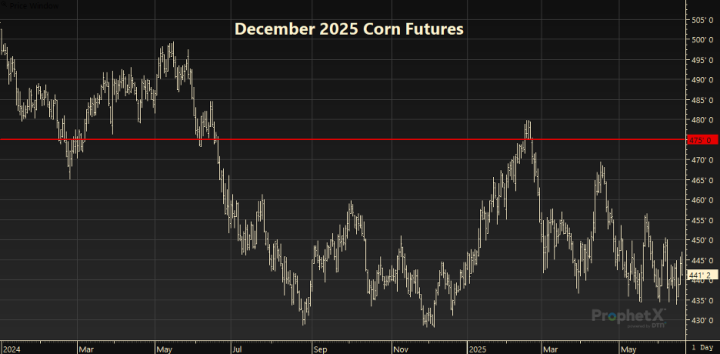
December corn finished its third week of closing between $4.35 and $4.50. In the last 77 trading sessions, Dec. corn only closed above $4.55 11 times and never above $4.70.
No opportunities
There have been virtually no opportunities to sell 2025 corn at a profitable value in the past year. After reviewing breakeven levels with many farmers throughout the United States, it seems the average farmer in the country needs a $4.75 futures value along with normal yields to turn a profit this season. As this chart shows, in the past year there were only four days where the price point was above the breakeven.
November beans managed to get a small boost from the biofuel mandate goals released last week and traded within one cent of the highest value seen in 2025. Unfortunately, that price point is still at least 50 cents below the breakeven value for the average U.S.… Continue reading
The June USDA report is typically one of the least exciting reports of the year, and this year’s was no exception as it offered few new insights. The trade will now wait for the biggest report of the year on June 30th, when the stocks and planted acreage are released.
Corn can’t seem to catch a break. The USDA report wasn’t bearish, but the market took it that way. There are several variables in the market right now that I’m watching, which could determine whether corn is leaning more bullish or bearish.
Reasons to Be Bullish Corn
The US corn crop is not made in the month of June
Corn’s export pace is approaching a new record
Current carryout levels are in the “snug” range
Global ending stocks continue to be lowered
Corn prices are substantially below the breakeven point for farmers
Old crop basis values continue to increase in most areas
Brazil continues to expand its corn for ethanol use
China’s domestic corn values are higher than imported prices
US corn delivered to Asia is competitive with Brazil
Wheat is starting to price itself out of feed rations in the southwest
Reasons to Be Bearish Corn
The US corn crop is not lost in the month of June
Planting pace was normal on the whole throughout the US
Drought conditions are currently limited and don’t appear to be growing
Brazil’s second corn crop continues to get bigger
The July / December futures inverse spread collapsed
Farmers still have an estimated 20% of old crop to market
There is too much sorghum left in the southwestern corn belt
No trade deals have been made
Corn struggles to rally on any positive news
The USDA could overstate corn used for feed
This week, beans had a massive basis drop from one of the largest crushers in the US, and futures still didn’t drop much.… Continue reading
By Barry Ward, Leader, Production Business Management
Lower crop prices and a mix of higher and lower input costs have set the stage for another challenging profit outlook for Ohio commodity crops in 2025. Supply and demand fundamentals have both continued to affect commodity crop prices negatively. Some input costs are projected to be higher, while others are expected to remain steady or decrease. The result of this set of economic fundamentals is an outlook for low to negative margins for the 2025 corn, soybean, and wheat crops.
Production costs for Ohio field crops are forecast to be steady to slightly higher than last year, with higher machinery and equipment costs leading the way. Lower crop protection chemical prices are offset by an expected increase in product need. Fuel and crop insurance costs are also projected to be slightly lower but land rents continue to increase on average.
Variable costs for corn in Ohio for 2025 are projected to range from $502 to $614 per acre, depending on land productivity.… Continue reading
Editor’s note: This story was written prior to the June 9 crop progress report. National totals for corn as of June 9 were 97% planted, in line with the five-year average. Ohio corn as of June 9 was 89% planted, slightly behind the five-year average of 94%. See the full report here.
Last month, while on an out-of-state vacation, I had a conversation with two ladies in the hotel elevator as they returned from a Sunday church lunch. When I asked them if they had enjoyed “church lady pie,” they had the most puzzling look on their faces. I was able to provide their missing puzzle piece. I explained that on tandem bicycle trips, especially during our weeklong cycling adventures on GOBA (Great Ohio Bicycle Adventure), when the lunch stop was at a church, Cindy was always looking for “church lady pies.” Cindy realized our search was always worthwhile, just as producers are looking for tasty meals after working in their corn, soybeans, wheat, and hay fields this summer.… Continue reading
Traders were looking for changes in U.S. old corn demand in the June 12 WASDE report, expecting exports to increase by 50 million bushels while corn used for feed could decrease by 25 million bushels. Additionally, increases in Brazil’s corn production were also anticipated. Here’s what actually took place – U.S. old corn exports increased by 50 million bushels, and U.S. old corn fed was unchanged. U.S. old corn ending stocks down 50 million bushels. Brazil’s corn production was unchanged.
After the report was released, corn was up 1 cent, soybeans down 4 cents, and wheat down 2 cents. Prior to the noon report, corn was up 3 cents, soybeans down 3 cents, and wheat down 2 cents.
U.S. ending stocks for the 2024-25 marketing year: U.S. corn ending stocks were 1.365 million bushels, down 50 million bushels, last month 1.415 billion bushels, and the average trade estimate was 1.392 billion bushels.… Continue reading
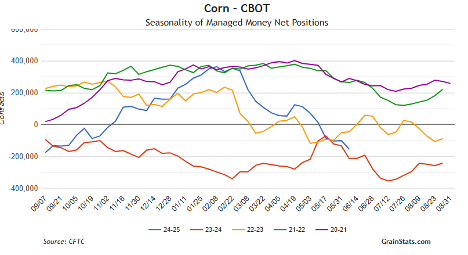
Over the last month, July corn has fallen from $4.70 to $4.40. Some of this drop may be attributed to funds going from a long of 350,000 contracts in February to being short 150,000 contracts this week, as seen in this chart:
In 2023 and 2024, funds were also short around 100,000 contracts by early June. In 2024, funds continued to push the market down by going to a short 350,000 contract position in July. Conversely, in 2023, they went to a long 50,000 contract position by mid-summer and helped take prices higher.
Ultimately, weather will impact the direction funds take over the next two months. Historically, when the crop is 70% planted by May 15, as it was this year, there is a 75% chance the crop will yield a trendline or above-average national yield.
What about late planting in the Eastern Corn Belt?
There are concerns with the planting progress in Ohio, Kentucky, and Pennsylvania.… Continue reading
June is National Dairy Month. I proudly remember growing up on the family dairy farm in Knox County. The work ethic instilled in me was a pivotal force in my ongoing career. Take time to enjoy some ice cream at one of the Ohio county fairs taking place this month in Paulding, Pickaway, Harrison, Putnam, and Hamilton counties.
The weather will once again be a major force for this growing season. The corn and soybean planting season in Ohio got off to a terrific start in mid-April. The last two weeks of April, numerous Ohio regions had some of the best planting conditions in years. “Stellar” and “beautiful” were often used to report planting conditions. However, frequent rain events in the first two weeks of May led to troublesome and frustrating delays. Isolated parts of Ohio expected more rain events in the second half of May, pushing planting dates backward into June.… Continue reading
Understanding spreads in the futures market is important for farmers to hedge their positions effectively and can help to maximize a farm operation’s profitability.
What is the spread?
The spread is the price difference between two different contract months. For instance, on Friday, May 9, the price for each contract month was:
May futures – $4.42
July futures – $4.50
September futures – $4.29
When the nearby month trades lower than the further out month, it is called a carry. The spread between May and July is an 8-cent carry, because the May at $4.42 is 8 cents less than the July at $4.50. A carry happens when the market needs someone to hold grain in storage until later months. The bigger the spread, the more incentive for someone to hold the grain longer.
Why is this important?
If done correctly, carry premiums can be a low-risk way for farmers to capture additional profits for their farm operation. … Continue reading
“Whatcha doing?” was both the question and the look veteran household cat Lizzie gave me one morning, her glare clearly signaling that I wasn’t moving fast enough to serve her breakfast. Similarly, producers across Ohio and the Midwest are asking themselves that same question—with multi-page to-do lists darting through their minds in a constant state of rapid-fire during this hectic time of year we call spring planting season. Be safe and stay focused!
The NASS Weekly Crop Progress Report of April 28 detailed that U.S. corn planting progress had reached 24%, up 12 points from the previous week and slightly ahead of that week’s five-year average of 22%. Meanwhile, Ohio’s corn planting reached just 8%; the previous week, it was 2%. U.S. soybean planting progress was a record 18%, the previous week was 8%, and the five-year average was 12%. Ohio’s soybean planting progress was 10%, ahead of the five-year average of 6%.… Continue reading
 Ohio Ag Net | Ohio's Country Journal Ohio Ag Net | Ohio's Country Journal