From farm to plate, the Ohio Department of Agriculture (ODA) is offering financial support to businesses and producers through the USDA’s Specialty Crop Block Grant Program. The 2026 Specialty Crop Block Grant (SCBG) Request for Proposals is now officially open as of April 1, 2026, pending confirmation of federal funding from USDA.
Specialty crops are fruits, vegetables, tree nuts, dried fruits, and horticulture and nursery crops (including floriculture). A full list can be found on the USDA’s Specialty Crop website. Grant awards will range from a minimum of $25,000 up to a maximum of $150,000. Last year, Ohio organizations were awarded more than $710,000.
Through USDA’s guidelines, the following entities are eligible to apply: food and agricultural non-profit organizations, cooperatives, associations or commodity groups, universities, and research institutions that represent specific specialty crop sectors. Projects benefiting only one single private individual, company, or organization are not eligible to apply.
My wife Ashley and I farm alongside our four kids and my parents, Chuck and Tammy. Together we raise corn, soybeans, wheat and processing tomatoes, along with some cattle. We also run a small you-pick operation with blackberries and raspberries outside of town. It keeps us busy, but that variety is part of what makes farming enjoyable for us.
Looking back at 2025, it was honestly a pretty solid year. We were able to get everything planted in good conditions, and that usually sets the tone for the rest of the season on our farm. Some fields missed out on a few rains during the summer, which probably trimmed the top end off some of the yields, but overall there really wasn’t much to complain about. By the time harvest wrapped up, I was pretty happy with how things turned out.
As we move into 2026, we’re not planning any major changes to the operation.… Continue reading
By Dee Jepsen, Wayne Dellinger, Amanda Douridas and Rob Leeds
Off-highway vehicles (OHVs) were originally designed for recreation, but their versatility has made them popular for work and transportation in rural areas, farms, and small communities. All-terrain vehicles (ATVs), utility terrain vehicles (UTVs), and recreational off-highway vehicles (ROVs) are now used for hauling equipment, maintaining property, and traveling short distances.
As their use expands, so do concerns about safety. Those concerns were addressed at the 2026 Ohio Safety Congress, with a three-hour workshop focused on the safe operation of OHVs in worksites, communities, and agricultural settings. The session highlighted the 3E Model of Safety — Engineering, Education, and Enforcement — as a comprehensive approach to reducing injuries and fatalities.
Engineering: Understanding vehicle design
OHVs have unique design features that distinguish them from passenger vehicles, motorcycles, and tractors. Understanding these characteristics is essential for safe operation.
In the latest in the agronomic video series from Beck’s Hybrids, Luke Schulte asks how population decisions impact return on investment. He dives into what the Practical Farm Research has found on the matter.
By Geraldo José Guimarães Isoldi, Terra Investimentos
With soybean harvest nearly completed in key states such as Mato Grosso, Paraná, Mato Grosso do Sul, and Goiás, Brazil’s 2025/26 soybean crop was estimated in CONAB’s latest report, released on March 13, at 177.85 million metric tons (6.9 billion bushels). This is a new record for the country. The result is supported by an average yield of 3,672 kilograms per hectare (54.60 bu/acre) across a harvested area of 48.43 million hectares (119.67 million acres). Even with important states like Rio Grande do Sul still in the early stages of harvest, the crop figures can already be considered largely consolidated.
CONAB also projects exports at 114.38 million tons, which, combined with 60.8 million tons allocated to domestic processing and other supply-and-demand variables, including imports, seed use, and beginning stocks, should result in ending stocks of 9.54 million tons.
By Brian Ravencraft, CPA, CGMA, Principal-Holbrook & Manter
Passing down a farm is more than a business transaction; it’s the transfer of a legacy. This process, known as succession planning, ensures the family farm continues to thrive for generations to come. Yet, many farmers delay this crucial conversation, often until it’s too late. I have seen it repeatedly throughout my career. This month, let’s look at why the time to start planning is now, and your accountant is a key partner in navigating the process.
Succession planning isn’t just about retirement. It’s a comprehensive strategy for transferring ownership, leadership, and operational responsibility. Starting the process between 5 and 10 years before you plan to step back provides the time needed to address complex issues without pressure.
Early planning allows you to align your personal retirement goals with the farm’s future. It gives the next generation time to develop the necessary skills and financial standing to take over.… Continue reading
While Ohio nitrogen rate recommendations are based on identifying the point on the yield response curve where the yield increase fully covers the cost of the last nitrogen applied, the database of corn response to nitrogen provides an opportunity to evaluate rate changes to maximize yield. Ohio corn yields have steadily risen over the past 45 years, but the amount of nitrogen fertilizer needed to maximize production has changed far less than many growers might expect, according to a new analysis from The Ohio State University Extension.
Researchers reviewed 431 nitrogen trials conducted between 1976 and 2021 across 31 Ohio counties, examining how yield trends, fertilizer needs, and nitrogen-use efficiency have evolved. The study, led by Fulford et al. (2025), offers a comprehensive look yet at how modern hybrids and agronomic practices have reshaped corn production.
On this week’s Ohio Ag Net Podcast, powered by Ohio Corn and Wheat, we’re talking spring crop management with Beck’s Hybrids agronomists Luke Schulte and Mike Hannewald. They discuss how growers can make smart decisions on corn populations, manage nitrogen in a volatile market, and get soybeans off to the best possible start this spring.
Plus, Joel Penhorwood visits with Michael Keith from K9 and Kin brands about Kalmbach Feeds pet food division and how their model is a little bit different from the rest of the pet food industry.
Then, ag retailer leaders were in Columbus for the Ohio AgriBusiness Association Legislative Day. Paul Poister, Nutrien’s manager of government and industry affairs, shares about his company’s “ask” to state lawmakers for 2026 and how global factors are impacting farmers right here in Ohio from a fertilizer standpoint.
By Dusty Sonnenberg, CCA, Field Leader, a project of the Ohio Soybean Council and Soybean Check-off
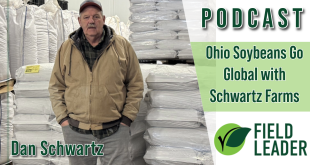
In Episode 69 of the Field Leader Podcast, Dusty visits with Dan Schwartz of Schwartz Farms in Trumbull County. The Schwartz family has been exporting food grade soybeans to the Japanese market since the late 1990s. Today they not only export their own beans, but also those of several farms that they contract with.
Dusty and Dan discuss the history of Schwartz Farms and the family members that make things happen today, along with the special relationships that have been developed with the processors in Japan.
After more than a century serving Ohio’s poultry industry, Eagle Nest Hatchery is entering a new chapter. Under new owner Dustin Drake, the long-standing hatchery has relocated to Mount Gilead, where Drake is expanding the operation while continuing its tradition of supplying poultry to generations of 4-H exhibitors.
Drake got his start in the poultry business through 4-H. He first partnered with his advisor, Bill Hershner, to form D&H Poultry. For the last 30 years, Drake has been breeding, hatching, and raising a variety of chickens and waterfowl.
That early involvement eventually connected Drake with Bill and Kay Karcher, the longtime owners of Eagle Nest Poultry.
“I worked with Bill and Kay Karcher very closely for the last 20 years and became great friends with them,” Drake said. “We worked back and forth getting birds from them, first from them when I was in 4-H, and then on up through my adult life.… Continue reading
For years, it’s been ingrained in our minds that one of the primary keys to higher corn yields is increasing plant population. After all, more harvestable ears, albeit smaller, will equate to higher yields, right?
For the last several years, Beck’s has been conducting significant research regarding this belief. Particularly with current genetics, we quickly learned that increasing plant population does not always lead to higher yields. More importantly, it doesn’t necessarily result in higher profitability.
While we proved that not all hybrids respond uniformly to increased plant population, initially, it was believed to be an above-ground competition factor. While leaf architecture and overlapping leaves competing for sunlight are components, Beck’s research indicates that root architecture likely has an even greater influence on population response.
Have you ever experienced tremendous success with a hybrid only to learn your next-door neighbor hates it? Or vice versa, a hybrid has failed on your farm, yet your neighbor wants to plant the entire operation in it?… Continue reading
Shelby County, Ohio, has found itself in a revealing split-screen moment. On the one side, township residents are packed into a county community hall to weigh in on the future of their farmland and to participate in a public process to testify that industrial wind and solar energy development threatens their soil, livelihoods, and the landscapes their families had tended for generations.
On the other side, inside the City of Sidney, the view looks entirely different. A $3 billion Amazon data center project is advancing not because residents were meaningfully consulted, but because a majority of city council members approved a property tax abatement on more than 200 acres of annexed farmland. Residents’ questions were heard only after decisions had essentially been made, and concerns were addressed only after the city had committed to Amazon’s most significant financial incentive.
So why is it that landowners in the townships have a formal voice about wind and solar projects that create energy, while city residents have none over a sprawling data center campus that consumes that same energy?… Continue reading
As uncertainties continue to mount, farmers continue to make adjustments to their 2026 crop plan. What are some of the inputs that could be cut and what is off-limits? Ty Higgins visits with Ryan Harbison from AgroLiquid about what he is hearing from Midwest growers and gives his advice to the question.
Ohio Ag Net’s Joe Everett visits with John Hinners, senior vice president of industry relations with the U.S. Meat Export Federation. They discuss growing export markets and what the future holds internationally for U.S. red meat.
Farmers in Morrow and Marion counties are raising concerns as the Ohio Department of Transportation evaluates a potential connector between U.S. 23 and Interstate 71. The state-required feasibility study has narrowed potential routes to three options in Marion and Morrow counties. And while still hypothetical, the proposal raises significant concerns about farmland loss, impacts to rural communities and overall costs to taxpayers.
Matt Clinger is a third-generation farmer near Cardington and says any proposed route would significantly impact his farming operation. ODOT is accepting public comments through April 14. Learn more about the connector study here.
A relatively small watershed in Hardin County is producing encouraging results in the ongoing effort to improve water quality flowing toward Lake Erie.
Researchers with The Ohio State University say the Shallow Run Pilot Watershed Project is already showing significant reductions in phosphorus runoff after just a few years of concentrated conservation practice adoption by farmers in the watershed.
“We’re seeing really exciting water quality improvements,” said Jay Martin, Ph.D., professor of ecological engineering in The Ohio State University College of Food, Agricultural, and Environmental Sciences. “We’ve been trying to reach a 40% reduction in phosphorus going into Lake Erie for many years and really haven’t seen the needle move much. This project is designed to show how we can move the needle.”
The Shallow Run watershed includes just over 5,200 agricultural acres in Hardin County, a small area compared to the larger Maumee River watershed, which covers roughly 3 million agricultural acres across northwest Ohio.… Continue reading
Last month, shortly after waking up, I was looking high and low for Jacob, my cat. Often, he is sleeping on my bed, and I know exactly where he is, but not that morning. His favorite place to sleep is a chair at the opposite end of the house. I slowly looked in numerous locations, eventually getting to his favorite chair. Still, no Jacob. Then, I retreated, thinking he must be hiding. And there he was, right in front of me as if to say, “Looking for somebody?” Here’s to hoping your spring planting efforts don’t have you scrambling for hours to connect with co-workers and secure supplies, as planting conditions can often be fleeting in the race to complete planting on time and efficiently.
The U.S. war efforts, which began last month, have been on the minds of Ohio and U.S. producers for weeks.… Continue reading
Columbus, OH — In a bold step into agri-entertainment, Ohio Ag Net is proud to announce the launch of the first-ever Farm Sportsbook, a new platform allowing farmers to legally place wagers on real-time rural action.
Available bets include:
First neighbor to drop the planter
Will there be 3 straight dry days in April?
Will Farmer Thompson’s bull jump the fence again before Memorial Day?
Lamb born with two heads? That’s +500 odds.
“Producers already gamble with the weather, markets and inputs, now they can do it intentionally,” said Ty Higgins, general manager of Ohio Ag Net.
Livestock pools, cover crop parlays, and bonus odds on how many fence posts Jim hits before lunch.
Risk it all, because nothing says “sound financial planning” like betting on agriculture.
Payouts in bragging rights, beef sticks, and possibly gift cards to Rural King.
Download the app or just shout your bets at the grain elevator or milk parlor.… Continue reading
At Spring Valley Farm near Mt. Gilead, a busy dairy never really slows down — but twice a month, things look a little different when Carrie McFarland rolls in with her purple chute.
McFarland, originally from Cardington and now based in Bellefontaine, has made a name for herself as one of Ohio’s go-to hoof trimmers. It’s a skilled trade that plays a big role in keeping cows comfortable, productive, and moving the way they should.
In this video, Ohio Ag Net’s Joel Penhorwood caught up with McFarland and dairy producer Andy Creswell to talk about her journey into the business, what goes into hoof trimming, and why this behind-the-scenes role is so important on today’s farms.
Read the full story: https://ocj.com/2026/03/the-story-of-carrie-the-hoof-trimmer/… Continue reading
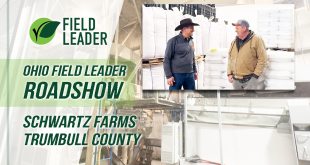
In this episode of the Ohio Field Leader Roadshow, Dusty Sonnenberg talks with Dan Schwartz of Schwartz Farms about the work that has been done on their Trumbull County operation to raise food-grade soybeans valued in the Japanese market.
Ohio Field Leader is a project of the Ohio Soybean Council and the soybean checkoff.… Continue reading
 Ohio Ag Net | Ohio's Country Journal Ohio Ag Net | Ohio's Country Journal