September 1, 2026 Crops, Ohio Field Leader, Ohio Field Leader - Podcast, Top Headlines
By Dusty Sonnenberg, Field Leader, a project of the Ohio Soybean Council and Soybean Checkoff
On this September episode of the Field Leader Podcast, Dusty is joined by Brandon Kern, Deputy Executive Director and Senior Policy Director of the Ohio Soybean Association and Ohio Soybean Council as well as Julia Brown, Communications and Education Director and Mackenzie Joseph, Communications Manager for the Ohio Soybean Council. The Ohio Soybean Hometown Tour made three stops in August with an action-packed agenda. The team will review how each of those stops went and what some of the takeaways were. They will also look ahead to the upcoming Farm Science Review and give us a preview of things to look forward to September 22-24 at the Ohio Soybean Building.
…
Continue reading Read More » September 1, 2026 Livestock, Top Headlines

By Brianna Smith
When Rick and Jayne Young purchased their Belmont County farm in 1995, there wasn’t much to the place besides rolling hills and plenty of potential.
“It was stripped down. There were no fences, no nothing. It was all bare ground,” Rick said. “We made our schedule, and then we just started building from there.”
The couple purchased about 230 acres of reclaimed strip-mined ground in southeastern Ohio with the goal of building a thriving cattle operation. Together, the couple worked around the clock, building fences, installing water lines, constructing their home and barns, and transforming the once-barren property into productive pasture.
The move to Ohio had been years in the making. Rick and Jayne had established a cow herd in West Virginia but were ready to expand by the mid-1990s.
“I told my wife I’d like to move over to Ohio,” Rick said. “She said, ‘Well, if you can find a piece of ground that we like, we’ll move.’… Continue reading
Read More » August 31, 2026 Livestock, Top Headlines

The U.S. Department of Agriculture is launching a new package of initiatives aimed at rebuilding the nation’s cattle herd, strengthening domestic beef processing and providing additional support for current and beginning ranchers.
Agriculture Secretary Brooke Rollins announced the Ranchers First Initiative Aug. 31, describing it as a sweeping effort to put American cattle producers at the center of the nation’s food supply.
The initiative comes as the U.S. cattle herd remains at a 75-year low. USDA said the new actions build on the department’s October 2025 Plan to Fortify the American Beef Industry and are designed to provide ranchers with additional risk management tools while addressing processing capacity and market concerns.
“President Trump promised to put the American ranchers first, and the Ranchers First Initiative delivers on that promise,” Rollins said in the USDA announcement.
One of the key components is a new Beef Retention and National Development, or BRAND, endorsement for Livestock Risk Protection insurance.… Continue reading
Read More » August 31, 2026 2026 Ohio Crop Progress Report, Crops, Top Headlines

Ohio crops continue to progress ahead of normal, with corn development running well above the five-year average and soybean pod set nearly complete across the state. Recent widespread rainfall boosted soil moisture supplies, helping maintain generally favorable crop conditions as corn begins to mature and soybeans move toward the early stages of leaf drop. USDA reports there were 5.1 days suitable for fieldwork during the week ending Aug. 30.
Corn reaching the dough stage is at 95%, ahead of last week’s 87%, and well ahead of the 88% five-year average. Corn reaching the dent stage is at 59%, ahead of last week’s 36% average, and above the 48% average. Mature corn for the state is sitting at 5%, right on with the 5% average. Ohio corn condition was rated 61% good to excellent, with 49% good and 12% excellent.
Soybean pod setting has reached 97%, ahead of last week’s 93% and above the 94% five-year average.… Continue reading
Read More » August 31, 2026 Livestock, Top Headlines, Videos
Ohio Farm Bureau is encouraging cattle producers to make their voices heard following the recently announced 90-day suspension of the tariff-rate quota on imported ground beef.
Ohio Ag Net’s Joel Penhorwood talks with Whittney Bowers, Director of State Policy and Grassroots Engagement with Ohio Farm Bureau, about concerns surrounding additional beef imports, an already uncertain cattle market, and the potential long-term impact on producers making herd and marketing decisions.
This is part of a series discussing this topic with Ohio’s prominent farm and cattle organizations.… Continue reading
Read More » August 31, 2026 Farm and Finance, Top Headlines

By Emily Zuver, Senior Assistant Accountant, Holbrook & Manter
Running a farm or agribusiness means watching every dollar. Feed, fuel, equipment, labor — the expenses add up fast, and even a small dip in prices can squeeze your bottom line. The good news? You don’t need a big budget or fancy technology to spend smarter. A few practical changes can free up cash and make your operation more resilient.
This month I will share five straightforward ways to trim your costs without cutting corners on quality.
1. Get a handle on your fuel and energy use
Fuel is one of the biggest expenses on most farms, so it’s a smart place to start. Keep your tractors and machinery well-maintained — clean filters, proper tire pressure, and regular oil changes all help engines run more efficiently.
Plan your fieldwork to reduce backtracking and idle time. Combining trips or grouping tasks by location can save more fuel than you’d expect over a full season.… Continue reading
Read More » August 31, 2026 Buckeye Briefs, Crops, Top Headlines

The Ohio Soybean Council is helping Ohio fire departments transition to safer, more sustainable firefighting products through its Soy-Based Firefighting Foam Reimbursement Program. Eligible departments can receive 50% reimbursement, up to $1,000, toward the purchase of SoyFoam™ TF-1122, a PFAS-free, soy-based firefighting foam from Cross Plains Solutions.
SoyFoam™ TF-1122 is the first and only firefighting foam to earn GreenScreen Certified Gold™ status. It is also 100% fluorine-free, made with ingredients grown by U.S. farmers, and certified readily biodegradable, providing an environmentally responsible alternative.
Funding is available on a first-come, first-served basis, with one application per department each year. For purchasing information, contact Pat Butler at 269-438-1653 or pkfoamsolutions@gmail.com (Lucas, Fulton, and Williams counties), or Chuck Stiver at 330-421-2714 or cstiver@nextgenbiosolutionsllc.com (all other Ohio counties).
To receive reimbursement, departments should submit their receipt and proof of payment to the Ohio Soybean Council by emailing mcorbi@soyohio.org or mailing materials to 918 Proprietors Road, Suite A, Worthington, OH 43085.
… Continue reading
Read More » August 30, 2026 Livestock, Top Headlines, Videos
Ohio cattle producers are facing a complicated stretch for the beef industry.
Ohio Cattlemen’s Association President Lindsey Hall joins Ohio Ag Net’s Joel Penhorwood to discuss the recent closure of Tyson’s Joslin, Illinois beef processing plant, concerns surrounding additional beef imports, historically tight cattle supplies, and what all of it could mean for producers here in Ohio.
This is the first in a multi-part series discussing this topic with Ohio’s prominent farm and cattle organizations.… Continue reading
Read More » August 30, 2026 Featured Audio, Podcasts, Top Headlines, Videos
The annual three-day Farm Science Review, hosted by The Ohio State University College of Food, Agricultural, and Environmental Sciences, brings farmers, researchers, educators, students and industry together to share what works and explore what’s next at the Molly Caren Agricultural Center near London, Ohio from Sept. 22-24. Get a preview from FSR manager, Nick Zachrich, on this Ohio Ag Net Podcast, powered by Ohio Corn and Wheat.
Plus, numerous livestock groups, including the Ohio Cattlemen’s Association, are raising concerns about the Trump administration’s reported plan to allow an additional 300,000 metric tons of tariff-free beef imports over the next 90 days. OCA President Lindsay Hall talks about how this move to more foreign beef would impact Ohio cattle producers in the short and long terms.
…
Continue reading Read More » August 30, 2026 Buckeye Barn Health, Livestock, Top Headlines

By Emily Nogay, VMD, MS, Ohio State University
Silent killers can come in all shapes and sizes. In small ruminants, the viruses caprine arthritis and encephalitis (CAE) and ovine progressive pneumonia (OPP) can go by many names. Commonly, they are referred to as small ruminant lentiviruses and fall into the category of wasting diseases, meaning they can cause progressive weight loss. These viruses are silent invaders because once they infect an animal, they can incorporate their own genetic material into the animal’s genome, making them hidden from the animal’s immune system and allowing the infection to persist for life.
Transmission of these lentiviruses is through another infected animal. The virus is shed through coughing, saliva, blood, colostrum, milk, and semen. Inanimate objects or surfaces generally do not transmit these viruses, as they cannot survive for very long in the environment. For the most part, CAE affects goats, and OPP affects sheep; however, they can rarely infect the opposite species.… Continue reading
Read More » August 30, 2026 Buckeye Briefs, Crops, Top Headlines

Ohio State University Extension and the Ohio AgriBusiness Association will again partner to hold the Farm Science Review Agronomy College on Wednesday, September 9. The event is designed to educate agronomists, Certified Crop Advisers, custom applicators and farmers on current agronomy issues. To register, please visit: https://oaba.net/aws/OABA/pt/sp/fsr
The full-day event features time with OSU Extension and industry specialists in the field at the agronomy plots. Breakout session topics will address the challenges of the 2026 growing season and technology opportunities available today and into the future.
Registration opens at 8:30 a.m. and the program will conclude by 4 pm. Participants will rotate between sessions throughout the day. Sessions are listed below and will be presented at various times throughout the day. Each session will be 60 minutes in length. ODA Pesticide Credits have been requested and CCA CEUs will be offered. Cost is $120 and includes lunch, materials and credits. Special rates for students are available by contacting Janice Welsheimer directly at jwelsheimer@oaba.net… Continue reading
Read More » August 30, 2026 Crops, Market Analysis, Top Headlines
By Doug Tenney, Leist Mercantile
“Corn day.” Instantly, you are drawn to your own unique stories as memories flood your mind. It could mean the first or last day of planting or harvest, harvesting with the grandkids, the day the last load of corn went to town, or going to the mailbox and seeing the check for that final load.
For me, corn day means gathering with siblings and their families. In a flash, I’m drawn back to my teenage years on the family dairy farm, sitting in front of a mountain of sweet corn. More than 60 dozen ears would be husked (yes, I already know yours was larger), silked, blanched, chilled in an ice-cold bath, cut, and frozen.
Siblings from down the road and even out of state traveled with their families to gather for corn day. The goal was always to freeze as much corn as possible while making sure there was plenty to savor right off the cob with butter and salt.… Continue reading
Read More » August 27, 2026 Crops, Top Headlines
By Ty Higgins, Ohio Ag Net
Agriculture is filled with new technology, data, and products designed to help farmers improve yields and efficiency. But the message at a recent Progressive Crop Solutions grower meeting was much less complicated. Start with the fundamentals.
Lead agronomist Lewis Stearns and business manager Kevin Ward discussed that message during the company’s customer appreciation meeting in Wyandot County in mid-August.
Stearns said the company’s work with data consistently points back to the importance of doing the basics well.
“Every year we analyze millions of data points. And what it always points to is we’ve got to get better at fundamental agronomy,” Stearns said. “We always want to jump on these shiny new things. And I do too. I want to be the guy out here talking about the latest biological or the latest technology that we’ve got to put into this crop.”
But technology should support sound agronomic decisions rather than replace them, he said.… Continue reading
Read More » August 27, 2026 Crops, Ohio Field Leader, Top Headlines

By Dusty Sonnenberg, CCA, Field Leader, a project of the Ohio Soybean Council and Soybean Checkoff
As we get closer to harvest, there is value in estimating the soybean crop’s yield. The closer we get to harvest, the more accurate the yield estimates become. Later-planted soybeans, replants, and double-crop beans will require more assumptions when gathering data. Marketing decisions and storage plans can be made and adjusted in a timely manner when a reliable yield estimate is available. There are several methods farmers can use to estimate crop yield. There are also A.I. tools now available to assist in the process.
Most methods require collecting basic information, such as plant populations, row spacing, pods per node, seeds per pod, seed size, node spacing, and average plant height in the field.
Shaun Casteel, Purdue University Extension Soybean Specialist, utilizes a soybean yield estimating method that takes the number of pods in 1/10,000 of an acre, multiplies it by the number of seeds per pod, and then divides by a seed size factor.… Continue reading
Read More » August 27, 2026 Country Life, Top Headlines
By Dan Armitage
For many Ohio hunters, the fall fun is underway. Early September marks the start of Ohio’s 2026-27 hunting seasons, with squirrel and mourning dove opening on Sept. 1. Several waterfowl hunting seasons open on that Tuesday as well, when rail, gallinule (aka moorhen), and snipe become fair game. On Sept. 5, the early goose season and early teal seasons begin, continuing through Sept. 13 statewide.
Of all those, dove hunting is my favorite. Not only is it the first chance to hear my gun go “boom” at live game since spring turkey season, but it’s one of the few hunting experiences where it’s often “the more the merrier” when it comes to keeping the feathered targets on the move and in the air. The other group hunting I enjoy is gun season deer drives. I am first and foremost an archery hunter when it comes to whitetails, which begins Sept.… Continue reading
Read More » August 27, 2026 Market Analysis, Top Headlines

By Mike Zuzolo, Global Commodity Analytics & Consulting LLC
Borrowing from a phrase in the 1990s about the economy: “It’s the grain demand, stupid.”
USDA confirmed in its August WASDE report continued tightening of supplies for both grains and cattle. Now the futures trade needs to come to grips with little, if any, demand rationing.
The headline story for the futures trade in USDA’s most recent monthly report was the reduced corn yield, in my view.
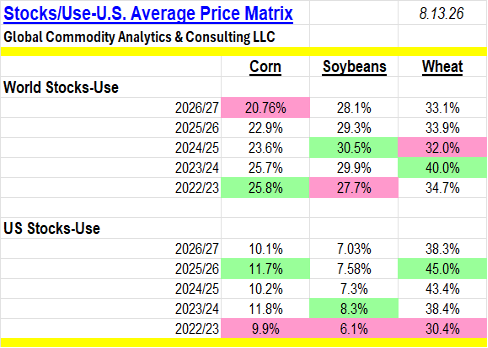
Just as important to me was the fact that USDA continued to increase U.S. corn exports in both the 2025-26 and 2026-27 marketing years. As a result of this, coupled with USDA increasing 2026-27 world corn exports, the world corn stocks-to-use ratio is now at a five-year low. The U.S. stocks-to-use ratio is also just 2% from matching the five-year low set back in 2022-23. See the Stocks/Use Matrix below.
When viewing the numbers from this angle, it seems much clearer to me that the U.S.… Continue reading
Read More » August 26, 2026 Crops, Top Headlines

By Ty Higgins, Ohio Ag Net
Fertilizer prices have become one of the biggest concerns facing farmers as commodity prices put pressure on farm margins, raising questions about competition, market concentration and the factors driving the cost of crop nutrients.
Ohio Corn and Wheat is among the agricultural organizations calling for greater competition and transparency in the fertilizer market. The Federal Trade Commission (FTC) has now taken an interest in those concerns, asking farmers, retailers and others in the fertilizer supply chain to provide information that could help with its investigation.
“I don’t think you can put two farmers together without the topic coming up of how input costs have gone, and they start to list inputs at fertilizer because it’s just been unexplainable, what’s going on,” said Ohio Corn and Wheat Executive Director Tadd Nicholson.
The concerns, he said, are not new. Fertilizer prices and availability have been an issue for several years, prompting Ohio Corn and Wheat and other organizations across the Midwest to take a closer look.… Continue reading
Read More » August 26, 2026 Country Life, Top Headlines

By Leisa Boley Hellwarth
Just a stone’s throw from Columbus, Ashville is a village in Pickaway County with 4,600 residents and an annual budget of $8.4 million. Like at least 200 other sites in the state, Ashville is dealing with a data center project. A data center is the physical space (or spaces) in which a company houses and operates its Information Technology hardware infrastructure. The developer, EdgeConneX, founded in 2009, builds and operates data centers worldwide. Their headquarters are in Northern Virginia, Singapore, and Amsterdam.
This Ashville project is now before the Ohio Supreme Court, which must decide who gets the final say when data centers come to Ohio communities. A ruling is expected by Aug. 5, 2026. Let’s take a look at how we got here.
The data center developer, EdgeConneX, asked local Ashville officials to approve the agreement. The proposed project, located on Route 752 on 200 acres within the village limits of Ashville, encompasses a data center campus with 2 data centers and an 800-megawatt natural gas power plant, large enough to power 600,000 homes.… Continue reading
Read More » August 26, 2026 Buckeye Briefs, Country Life, Top Headlines

Ohio landowners and oil and gas well owners will see several changes to state law beginning Sept. 23, when Senate Bill 219 takes effect.
Gov. Mike DeWine signed the legislation June 25, marking the first major update to Ohio’s oil and gas laws since 2012. According to The Ohio State University Farm Office, the law includes several provisions affecting private landowners, oil and gas leases, well owners, permitting, and orphaned wells.
One significant change establishes a 10-year statute of limitations for claims alleging an oil and gas lease has terminated or is no longer in effect. The provision replaces a longer timeframe established by a 2019 Ohio Supreme Court decision.
S.B. 219 also changes how Ohio Department of Natural Resources orders can be appealed. Appeals must now go first to the Ohio Oil and Gas Commission rather than directly to a county court of common pleas.
Other provisions modify expedited drilling and well-plugging permit reviews, streamline the process for assigning or transferring wells, and clarify that landowners may plug orphaned wells on their property and seek reimbursement from ODNR.… Continue reading
Read More » August 26, 2026 Country Life, Top Headlines

The Ohio Farm Transition Network is hosting a series of regional, one-day professional training events designed to build a more unified and effective approach to farm transition planning across Ohio. The training series will bring together agricultural service providers from a wide range of disciplines to strengthen expertise, foster collaboration and improve the quality of transition support available to Ohio farm families.
Attorneys, accountants, lenders, financial advisors, insurance professionals, Extension educators, and other agricultural professionals are encouraged to attend. The sessions are designed to promote cross-disciplinary understanding and establish consistent terminology and best practices among professionals who play a vital role in helping farm families successfully navigate transition and succession planning.
Participants will receive practical guidance on key topics including farm transition strategies, legal business structures, tax considerations, financial planning tools, and a lender’s perspective on transition planning. The training sessions are open to both OFTN members and nonmembers, providing an excellent opportunity for professional development, networking, and alignment with emerging industry best practices. … Continue reading
Read More » Ohio Ag Net | Ohio's Country Journal Ohio Ag Net | Ohio's Country Journal